


Written by Kshitij Kumawat · Ujjain local, documenting Mahakaleshwar since 2018
Independent guide — kept up to date and verified against the official temple portal www.shrimahakaleshwar.mp.gov.in
Quick Reference: Mahakaleshwar Temple Ujjain. Complete 2026 Visitor Guide
- Mahakaleshwar Temple: Ujjain, MP. One of 12 Jyotirlingas. Open 3 AM to 11 PM daily.
- Bhasma Aarti: 4 AM daily ash-anointing ritual. Paid pass 1,500 to 3,000 rupees.
- Booking: Only on official www.shrimahakaleshwar.mp.gov.in. 60-day advance window.
- Disclaimer: We do not facilitate bookings. Beware of fake agents charging extra.
Mahakaleshwar Temple in Ujjain is one of the 12 Jyotirlingas of Lord Shiva and the only south-facing one. The temple opens at 3:00 AM and closes at 11:00 PM. The famous Bhasma Aarti runs daily from 4:00 AM to 6:00 AM. This guide covers every visitor question for 2026.
Quick facts about Mahakaleshwar Temple
- Location: Ujjain, Madhya Pradesh, India
- Built: Self-manifested lingam, current structure 18th century by Maratha Ranoji Shinde
- Daily visitors: 30,000 to 50,000 (5 lakh on Mahashivratri)
- Free general darshan plus 4 paid pass types
- Mahakal Lok corridor added October 2022, 900 meters long
Temple timings
| Period | Time |
|---|---|
| Open | 3:00 AM |
| Bhasma Aarti | 4:00 AM to 6:00 AM |
| Bhog Aarti (closed for darshan) | 10:30 AM to 11:15 AM |
| Sandhya Aarti (closed) | 7:00 PM to 7:45 PM |
| Close | 11:00 PM |
4 ways to enter the temple
- Free general queue: 3 to 4 hours wait, no booking
- VIP Shighra Darshan: 250 rupees, 45 minutes
- Garbh Grah Darshan: 750 rupees, touch the lingam
- Bhasma Aarti VIP: 1,500 to 3,000 rupees, 4 AM ritual
How to reach Mahakaleshwar Temple
- Indore Airport: 56 km, 1 hour 20 min by cab
- Ujjain Junction: 2 km, 10 min by cab or auto
- From Bhopal: 190 km, 3.5 hours
- Indore to Ujjain expressway: 53 km, 75 min
Dress code
Bhasma Aarti has strict dress code. Men: dhoti or full pants with shirt. Women: saree or salwar suit, no jeans or Western wear. General darshan has relaxed rules but no shorts or sleeveless tops.
Best time to visit
October to March is the comfortable window. Avoid May to June (44 deg C heat). Peak crowd: Mahashivratri (15 Feb 2026), all Sawan Mondays (July to August), Nag Panchami (11 Aug 2026), Kartik Mela (November).
Where to stay near the temple
Hotels within 1 km of the temple range from 800 rupees (budget lodges) to 8,000 rupees (4-star). For early Bhasma Aarti slots, stay within 500 meters so you can walk to Gate 4 by 3 AM. See hotels near Mahakal Temple.
Why Mahakal Is Different From Every Other Jyotirlinga
Two things set this temple apart, and locals will tell you both within your first hour in Ujjain. First, the lingam here is dakshinamukhi — south-facing — the only one among the twelve Jyotirlingas oriented this way. South is the direction of Yama, of death and time, and Mahakal literally means the great lord of time. The belief that flows from this is simple and enormous: the deity who governs time itself sits in Ujjain, and death holds no fear for those under his gaze.
Second, tradition holds that Mahakal is the true king of Ujjain — which is why, by long-standing custom, no ruling king or head of government stays overnight in the city. One sovereign per city, the saying goes. Whether you take that as history or poetry, it tells you how completely this temple defines the place around it. For the deeper story of the temple’s destruction and rebuilding across the centuries, our Mahakal temple history page traces it era by era.
Understanding the Bhasma Aarti — Legend and Reality
The 4 AM Bhasma Aarti is the ritual this temple is famous for, and it deserves an honest explanation. The legend says that in ancient times the lingam was adorned with fresh ash from the cremation grounds — a stark reminder that everything, in the end, returns to Mahakal. That is the story, and it is part of what gives the ritual its charge.
What actually happens today: the priests bathe and adorn the lingam, then offer consecrated vibhuti — sacred ash prepared from dried cow dung — in swirling clouds while drums and chants fill the sanctum. It remains one of the most intense ritual experiences in India. Seated passes cost around ₹200 and are issued only through the official portal, shrimahakaleshwar.mp.gov.in. Arrive between 2:30 and 3:00 AM, men in dhoti, women in saree or suit, and leave your phone behind — devices are banned near the sanctum.
Walking the Temple Complex: What Sits Where
Most visitors see only the main sanctum and leave. Give the complex an extra half hour and it opens up. The temple rises in three levels: Mahakaleshwar in the garbhagriha below, the Omkareshwar shrine on the floor above it, and at the top the Nagchandreshwar temple — famously opened for darshan only around Nag Panchami each year.
Around the courtyard you will find shrines to Ganesh, Parvati, and Kartikeya, and the large kund whose waters are held sacred. Take a slow circuit after your darshan; the crowd thins dramatically once you are ten metres past the sanctum exit.
Mahakal Lok: the new grand approach
The Mahakal Lok corridor, inaugurated in 2022, turned the temple approach into a 900-metre open-air gallery of Shiva. You pass towering statues, sandstone columns, and murals telling stories from the Shiv Purana. Walk it twice if you can: once by day to read the panels, once after dark when the lighting transforms it. Photography is welcome here, which makes it the memory-making stretch of your visit.
A Typical Darshan, Step by Step
Here is how a general darshan flows, so nothing surprises you. You leave footwear and phones at the counters near the entrance (free or nominal charge), pass through security, and join the queue that channels through the Mahakal Lok side. Barricaded lanes wind toward the sanctum area — on a normal weekday you are looking at one to three hours, moving most of the time.
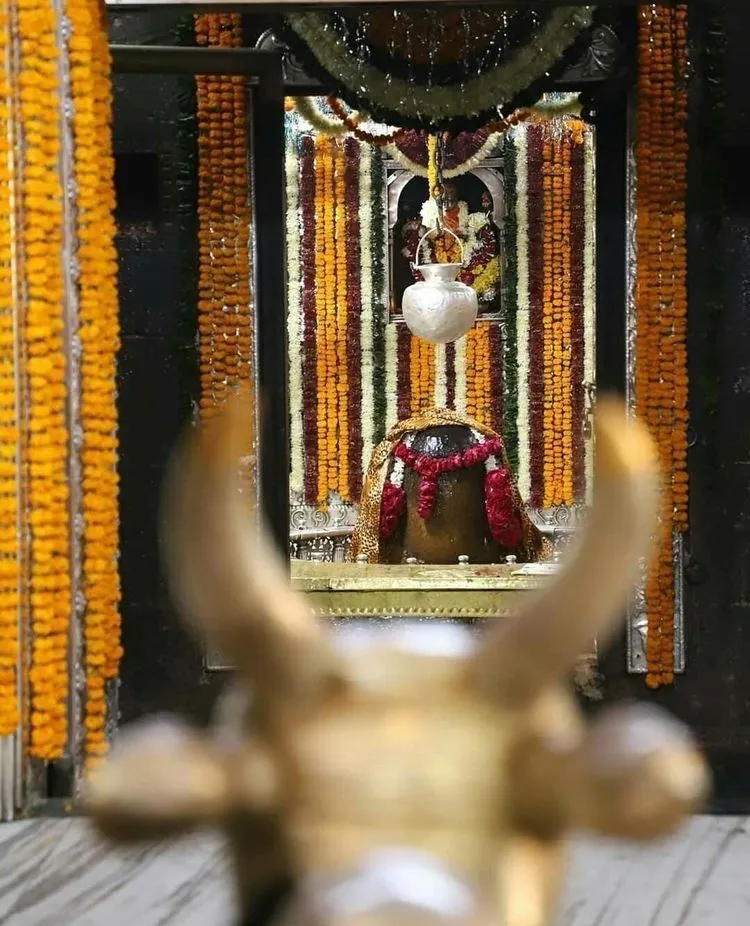
The darshan itself comes from the sanctum doorway or the hall in front of it: a clear view of the jyotirlinga, silver-serpent crowned, usually dressed in flowers or fresh shringar. You will get seconds, not minutes — the line behind you is endless, and the attendants keep everyone moving. Fold your hands, take your moment fully, and step through. Then slow down: the courtyard shrines, the kund, and the corridor are yours at whatever pace you like. If your time is short or you are travelling with elderly family, the paid fast-track options are covered honestly in our VIP darshan ticket guide.
The Rhythm of the Temple Day
The temple lives by a fixed pulse. The day opens with the Bhasma Aarti at 4:00 AM. After it concludes, free general darshan runs through the day until roughly 10:30 PM, punctuated by the scheduled aarties — morning, midday bhog, evening, and the final shayan aarti before the doors close. During each aarti, darshan movement pauses briefly; if you hear the drums begin as you queue, count yourself lucky rather than delayed, because the sound rolling through the stone halls is half the experience.
Early morning after Bhasma Aarti and late evening after 8 PM are the quietest windows on ordinary days. Mondays, festival days, and the whole month of Sawan run on a different scale entirely — expect multiplied crowds and modified arrangements.
Temple Etiquette Locals Wish Visitors Knew
- Dress simply and modestly even for general darshan — no shorts, no sleeveless tops. Traditional wear is required only for the Bhasma Aarti, but it is never out of place.
- Do not fight the queue attendants for extra seconds at the sanctum. The system moves lakhs of people; grace is part of the worship.
- Prasad and offerings are best bought from the official counters inside, not from touts outside promising “special entry.”
- Water from the kund is for sprinkling, not bottling.
- Keep your voice low inside the inner halls. The temple is loud with devotion, not conversation.
After Your Darshan: the Perfect Ujjain Half-Day
Mahakal anchors a city full of sacred sites within a few kilometres. Walk to Harsiddhi Temple nearby, whose lamp-covered pillars blaze on festival evenings. Take an auto to Kal Bhairav, the city’s fierce guardian deity. End the day at Ram Ghat on the Shipra for the evening aarti — small, riverside, and quietly beautiful in a way that balances the morning’s intensity. Our places to visit in Ujjain guide maps a full circuit with timings and auto fares.
Quick Answers Visitors Ask Us Most
Is one day enough for Mahakaleshwar?
Yes, comfortably — Bhasma Aarti or morning darshan, the courtyard shrines, and the Mahakal Lok corridor fit into a single day with time left for Ram Ghat at sunset. Two days lets you add the wider Ujjain temple circuit without rushing anyone.
Can I attend Bhasma Aarti without a pass?
The seated experience inside requires the pass booked on the official portal — around ₹200, and only from shrimahakaleshwar.mp.gov.in. There is no legitimate way to buy one at the gate or through agents. If you miss out, come for general darshan just after the aarti concludes; the temple is at its calmest then.
Are elderly or mobility-limited visitors looked after?
Better than most large temples. Wheelchairs are available at the main entrance, the corridor route is step-free for long stretches, and attendants generally wave elderly pilgrims into gentler lines. Keep the visit early-morning or late-evening, avoid festival Mondays, and build in resting stops.
What should I offer at the temple?
Bilva leaves, flowers, and simple sweets from the official counters are the traditional offerings; milk and water abhishek arrangements are managed through the temple’s own systems rather than items you carry in. Skip anything a street tout insists is “compulsory” — nothing at Mahakal is sold under compulsion, and the darshan itself asks for nothing but your presence.
One last local tip: however you plan your visit, build in slack. The queue may be longer than promised, the aarti may run late, the crowd may surge. Ujjain teaches you quickly that Mahakal’s timetable outranks yours — and by the time you leave, you will probably agree that this is exactly as it should be.