


Written by Kshitij Kumawat · Ujjain local, documenting Mahakaleshwar since 2018
Independent guide — kept up to date and verified against the official temple portal www.shrimahakaleshwar.mp.gov.in
Verified Snapshot: Before London Became the World’s Clock, Every Map on Earth W
- Mahakaleshwar Temple: Ujjain, MP. One of 12 Jyotirlingas. Open 3 AM to 11 PM daily.
- Bhasma Aarti: 4 AM daily ash-anointing ritual. Paid pass 1,500 to 3,000 rupees.
- Booking: Only on official www.shrimahakaleshwar.mp.gov.in. 60-day advance window.
- Disclaimer: We do not facilitate bookings. Beware of fake agents charging extra.
Open any world map and you will see a vertical line running through Greenwich, London. It is called the Prime Meridian — the zero line of longitude from which all positions on Earth are measured. All time zones are calculated from it.
Most people assume it has always been in London.
It hasn’t.
For over 1,500 years — from at least the 4th century AD until 1884 — the zero meridian of the world ran through a city in central India.
It ran through Ujjain.
Through the city where Mahakal, the God of Time, has been worshipped since before recorded history. And this is not mythology. It is documented in astronomical treatises, confirmed by multiple civilisations, and recorded in historical texts that predate Greenwich by more than a thousand years.
What Is the Prime Meridian and Why Does It Matter?
The Prime Meridian is the 0° line of longitude — the reference point from which all other positions east and west are measured. Without a fixed zero point, navigation, calendar-making, and time-keeping across regions is impossible.
Every ancient civilisation needed one. The question was: where?
The Greeks placed it variously at Alexandria and the Canary Islands. The Arabs had their own. Medieval Europeans used Jerusalem.
But India — specifically the astronomical tradition codified in the Surya Siddhanta (4th–5th century AD) and carried forward by Aryabhatta, Varahamihira, Brahmagupta, and Bhaskaracharya — established their zero meridian at Ujjain. And they had extraordinary reasons for doing so.
Why Ujjain? The Astronomy Is Remarkable
The ancient Indian astronomers who chose Ujjain as the zero meridian were not making an arbitrary or religious decision. The choice had precise astronomical logic.
1. The Intersection of Two Critical Lines
According to the Surya Siddhanta, Ujjain sits at the intersection of the zero meridian (0° longitude in the ancient Indian system) and the Tropic of Cancer (approximately 23.5° North latitude). To ancient astronomers, a point where two such significant astronomical lines cross was the most logical place to anchor all measurement. It is, literally, where the sun stands overhead on the summer solstice — the peak of solar power — while also being the world’s longitudinal reference point.
The ancient texts called this position the navel of the earth.
2. Confirmed by Ptolemy
The Greek astronomer Claudius Ptolemy, writing in the 2nd century AD, references “Ozene” — his transliteration of Ujjain — in his geographical calculations. The fact that a Greek astronomer writing in Alexandria was tracking Ujjain as a significant astronomical reference point confirms the city’s international standing as a geographic anchor.
3. The Greatest Astronomers Worked Here
Ujjain was not merely the theoretical zero point — it was the operational headquarters of ancient Indian astronomy. The great Ujjain tradition produced: Varahamihira (6th century AD), Brahmagupta (7th century AD) — who invented the concept of zero and worked from Ujjain, and Bhaskaracharya (12th century AD) — head of the astronomical observatory at Ujjain.
The famous Vedh Shala (Jantar Mantar) observatory in Ujjain, built by Maharaja Jai Singh II of Jaipur in the 18th century, was specifically constructed at this location because of its ancient status as the world’s astronomical reference point.
Why Was the Meridian at Ujjain Called “Mahakal’s Meridian”?
“Mahakal” means the God of Time. Kaal = Time. Maha = Great. Shiva as Mahakal is the deity who controls time itself — its beginning, its movement, its end.
The city where time was literally measured — where the astronomers calculated the zero point from which all positions and all hours were determined — was the city of Mahakal.
This is not a coincidence the ancients overlooked. It was, for them, the entire point. The God of Time resided precisely at the place where time was calculated for the entire world. The temple and the observatory were two expressions of the same idea.
What Happened in 1884
In October 1884, representatives of 25 nations met in Washington DC for the International Meridian Conference. They voted to establish the Prime Meridian at Greenwich, London — the location used by British navigators and the British Empire’s charts, which had become the most widely distributed maritime reference in the world.
The vote was 22 nations for Greenwich, 1 against (Haiti), and 2 abstaining (France and Brazil).
India, under British colonial rule, had no vote.
The ancient astronomical tradition of Ujjain — 1,500 years older than the Greenwich convention — was simply overruled by imperial geography.
Today, the Vedh Shala observatory in Ujjain still stands. The instruments still work. The local time calculated from Ujjain’s longitude is approximately 5 hours and 30 minutes ahead of Greenwich — which is, not coincidentally, exactly Indian Standard Time.
The Temple and the Observatory: Two Faces of One Truth
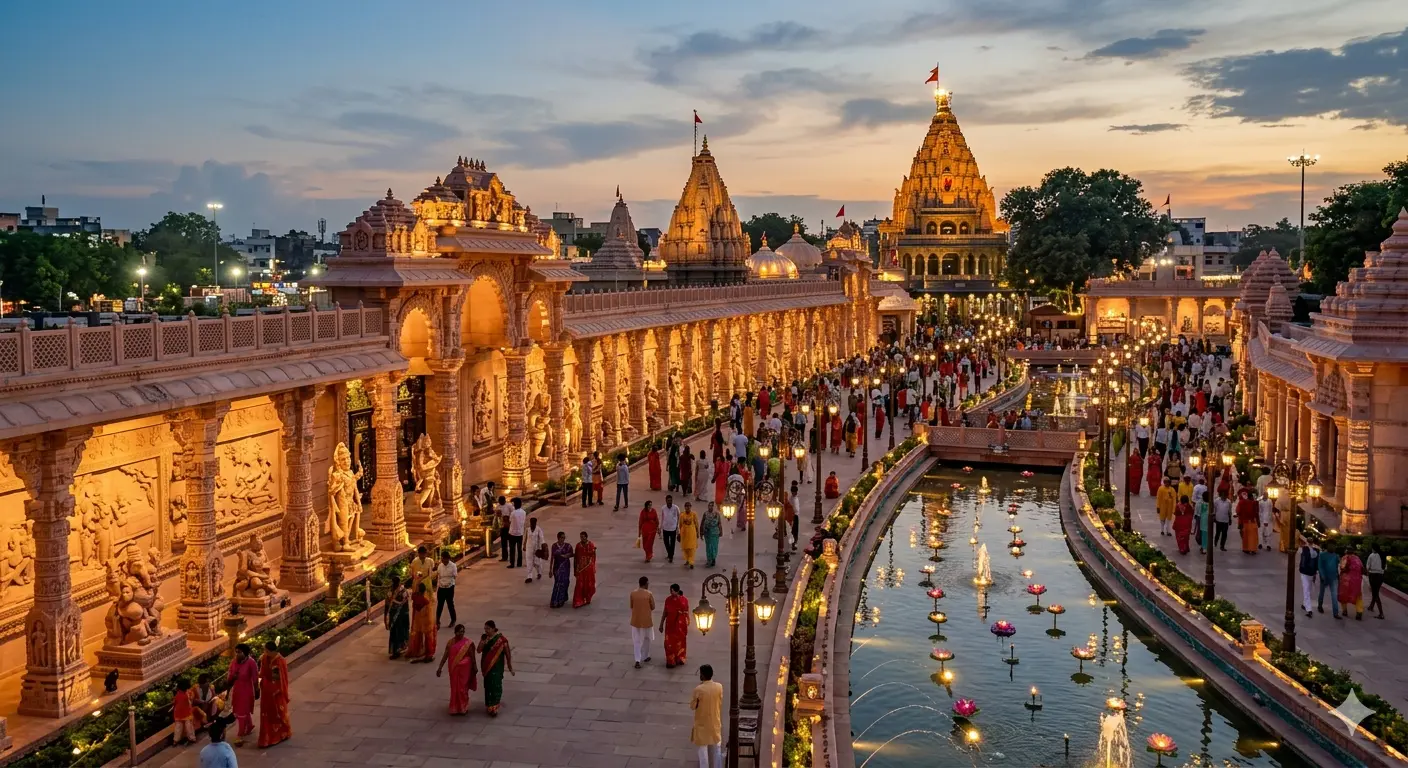
The Mahakaleshwar Temple and the Vedh Shala observatory in Ujjain are located less than 2 km apart. One measures time through ritual and devotion. The other measured it through mathematics and astronomy. Both were built on the same premise: that Ujjain is the place where time itself is anchored.
When you attend the Bhasma Aarti at Mahakaleshwar — when you stand in the pre-dawn darkness at 4 AM as the priests begin the ritual precisely on schedule — you are participating in a tradition of time-keeping that is older than Greenwich by a thousand years.
Mahakal was the lord of time before London decided it owned time.
And in Ujjain, he still is.
The Astronomers Who Worked Under Mahakal’s Sky
A zero line is only as good as the people who use it, and Ujjain’s meridian was worked by some of the greatest minds India ever produced. Tradition places Varahamihira — the sixth-century master whose Brihat Samhita ranged across astronomy, eclipses, weather, and architecture — in Ujjain’s orbit, and remembers him as one of the jewels of the city’s golden age. Brahmagupta, the mathematician who gave the world formal rules for calculating with zero, is remembered as the head of the astronomical school connected with Ujjain. For centuries after them, when a Siddhanta text stated planetary positions, it stated them as measured from the Ujjayini meridian — the reference line from which every serious calculation began.
These were not priests decorating a holy city with numbers. They were working scientists — observing, correcting, and arguing across generations — and Ujjain was their laboratory. The city carried two kinds of authority at once: the temple held the God of Time, and the scholars held the mathematics of time. Neither found this a coincidence.
Vedh Shala: The Observatory That Never Retired
The story did not end with the ancients. Around 1725, Sawai Jai Singh II — the astronomer-king of Jaipur, then serving as governor of Malwa — chose Ujjain for one of his five great masonry observatories, precisely because the old zero line ran through it. The Vedh Shala he built still stands south of the city centre: monumental instruments of stone and lime, including the Samrat Yantra, a giant sundial that reads time from the fall of a shadow, alongside instruments for tracking the declination and position of celestial bodies.
What sets Ujjain’s Vedh Shala apart from its sister observatories is that it never fully retired. It continues to be used for astronomical calculation and public education, and an annual ephemeris is still prepared here — which means the city that once set the world’s clock has, in its own quiet way, never stopped calculating.
The Zero Line That Lives On in the Panchang
Greenwich won the map in 1884, but it never conquered the panchang. The Hindu almanac tradition that fixes festival timings, muhurats, and eclipse moments descends directly from the Siddhanta astronomy that was anchored at Ujjain, and the city remains a revered reference point within that living system. There is a fitting symmetry in this: the timings that matter most to pilgrims — festival dates, aarti schedules, auspicious hours — are still best confirmed the traditional way, against the panchang and the temple’s official portal, rather than assumed from a printed calendar.
Stand at the observatory and this becomes more than trivia. The instruments around you were calibrated for this latitude and this longitude — the same coordinates the Siddhantas treated as zero. Ujjain’s meridian was never arbitrary; it was an observation, refined by generations who checked it against eclipses and planetary returns. When the Tropic of Cancer’s geometry, the city’s ancient reputation, and the still-working sundial all agree, you begin to understand why fifteen centuries of astronomers never felt the need to move their line. Greenwich was chosen by a vote of delegates in a conference hall. Ujjain was chosen by the sky.
Standing on the Old Zero Line
For the visitor, this is one of Ujjain’s most rewarding pairings: the temple and the observatory, faith and mathematics, within a single short auto ride of each other. Give the Vedh Shala an unhurried hour in the late afternoon, when the shadows are long enough to watch the Samrat Yantra actually at work, and then turn back toward the temple as the evening aarti approaches. You will have crossed, in one afternoon, both faces of the same idea — that time is sacred, and that Ujjain was once where humanity measured it from. The full city circuit is mapped in our guide to places to visit in Ujjain, and the deeper story of the shrine that gave the meridian its name is told in our Mahakal temple history.