


Written by Kshitij Kumawat · Ujjain local, documenting Mahakaleshwar since 2018
Independent guide — kept up to date and verified against the official temple portal www.shrimahakaleshwar.mp.gov.in
Quick Guide: A Hidden Temple Inside Mahakaleshwar Opens Just ONE Day a Ye
- Mahakaleshwar Temple: Ujjain, MP. One of 12 Jyotirlingas. Open 3 AM to 11 PM daily.
- Bhasma Aarti: 4 AM daily ash-anointing ritual. Paid pass 1,500 to 3,000 rupees.
- Booking: Only on official www.shrimahakaleshwar.mp.gov.in. 60-day advance window.
- Disclaimer: We do not facilitate bookings. Beware of fake agents charging extra.
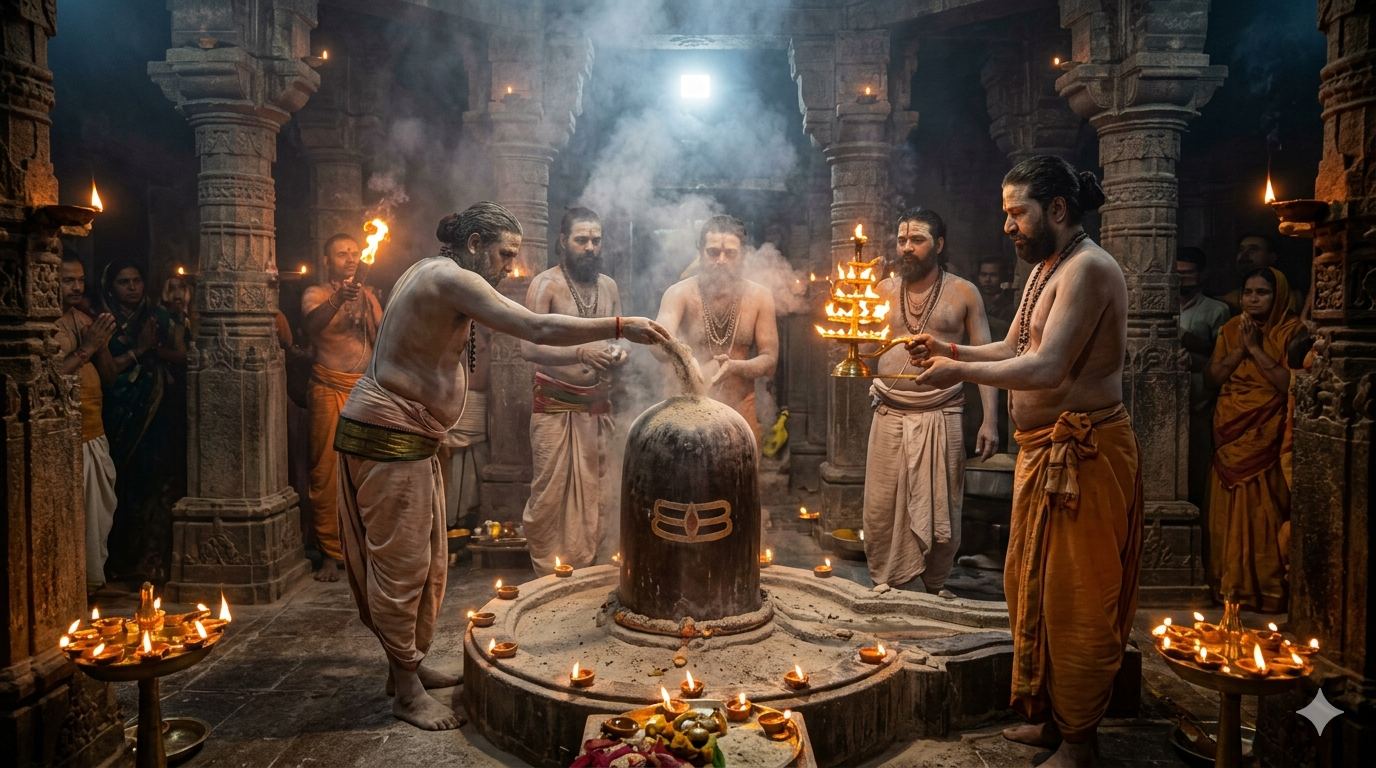
Every year, millions of people visit Mahakaleshwar Temple in Ujjain. They attend the Bhasma Aarti. They take darshan of the Jyotirlinga. They walk the Mahakal Corridor.
And almost none of them know that above their heads, on the third floor of the same temple complex, there is a shrine that has been sealed shut since the last time they visited.
It will be sealed shut again tomorrow. And the day after. And every day for the next 364 days.
This temple — the Nagchandreshwar Mandir — opens for exactly one night per year. Just one. For 24 hours, on the festival of Nag Panchami, the doors open and devotees may enter. Then they close again for another full year.
In all of India, there is no other major temple with this restriction. Not one.
What Is the Nagchandreshwar Temple?
The Nagchandreshwar Temple is located on the topmost floor of the Mahakaleshwar Temple complex — the third tier of the tower that rises above the main Garbhagriha where the Jyotirlinga is housed.
The deity worshipped here is Nagchandreshwar — Lord Shiva in the form of the Serpent-Moon God. The idol is remarkable and unique: it shows Shiva and Parvati seated on a throne made of the ten-headed serpent Ananta (the cosmic snake), with the snake’s hood spread protectively over the divine couple. Garuda, the eagle vehicle of Lord Vishnu, is also depicted — an unusual combination that carries deep symbolic significance about the harmony of cosmic forces.
The idol is considered extraordinarily powerful. According to temple tradition and local belief, the concentrated divine energy of the Nagchandreshwar shrine is so intense that unrestricted public access would be spiritually overwhelming. Hence the restriction.
Why Only One Day?
The explanation given by temple priests and backed by scriptural tradition is this:
Nag Panchami — the fifth day of the bright fortnight in the month of Shravan (July/August) — is the day sacred to serpents (nagas). On this day, serpents are worshipped across India. Snakes are brought milk offerings. Temples with serpent deities see massive crowds.
For Nagchandreshwar specifically, Nag Panchami is the one day when the deity is considered most receptive to the prayers of devotees — when the cosmic alignment of the day matches the nature of the deity. On this day alone, the shrine opens.
The timing of the annual opening is treated as a major event. Temple priests perform special rituals. Devotees line up from the previous night. By morning, queues stretch out of the temple complex and down the street. In peak years, hundreds of thousands of people attempt to take darshan within the 24-hour window.
What Happens on Nag Panchami at Mahakaleshwar
The 24-hour opening of Nagchandreshwar follows a strict schedule. The doors open at midnight at the start of Nag Panchami. Special pujas are performed throughout the night by senior temple priests. Devotees begin entering from early morning. The queue during peak hours can mean a wait of 4–6 hours. The doors close precisely 24 hours after opening.
Inside the small chamber, the idol is adorned with fresh flowers, sandalwood paste, and milk offerings. The atmosphere is described by those who have experienced it as unlike any other darshan in the temple — deeply concentrated, very quiet, and profoundly affecting.
The Three Floors of Mahakaleshwar: A Temple Within a Temple
Most visitors to Mahakaleshwar are unaware that the temple complex contains three distinct levels of worship, each with its own deity.
Ground Level (Underground Garbhagriha): The main Mahakaleshwar Jyotirlinga — the self-manifested Shivalinga that faces south. This is what most visitors come to see.
First Floor: Omkareshwar — a shrine to the Omkareshwar Jyotirlinga form of Shiva, one of the 12 Jyotirlingas.
Third Floor (Top): Nagchandreshwar — sealed 364 days a year.
This vertical arrangement — from the deepest underground to the highest point of the tower — is a deliberate architectural and spiritual design. The further up you go, the more restricted and concentrated the divine energy. The underground linga is accessible daily to thousands. The top-floor shrine admits the world for one day only.
How to Plan Your Visit for Nag Panchami
If you want to experience the Nagchandreshwar darshan: Nag Panchami falls in July or August each year (specific date varies by Hindu calendar). Arrive early — the queue builds rapidly after opening. Book accommodation in Ujjain well in advance as hotels fill up weeks before Nag Panchami. Plan to combine with Bhasma Aarti (4 AM) and join the Nagchandreshwar queue on the same morning for a complete Mahakaleshwar experience.
The Serpent at the Heart of Shiva’s World
To understand why this shrine opens on Nagpanchami of all days, you have to understand what the serpent means in Shiva’s universe. The snake coiled around Shiva’s neck is not an ornament and not a pet. It is Vasuki — fear itself, mastered and worn like jewellery. In yogic language the serpent is coiled energy waiting to rise; in the language of myth it is time, coiled and patient, that spares no one. Every other god subdues the serpent or flees it. Shiva alone wears it.
Nagpanchami is the one day the Hindu calendar sets aside to honour that power directly. Across India, families offer milk at serpent shrines and paint naga images beside their doorways. In Ujjain, the honouring goes a step further than anywhere else: the serpent-form of Shiva himself is unveiled, one floor above the Jyotirlinga, for a single turning of the clock.
An Idol That Waits in the Dark
What the darshan actually reveals is an image found in this form nowhere else. Shiva and Parvati sit together upon the coils of a great serpent, its hood spread above them like a canopy — the fearsome made domestic, the deadly turned into a throne. The idol is believed to date from around the 11th century, and one tradition holds that it was brought to Ujjain from Nepal. Scholars debate the details; devotees do not particularly mind. What matters to the lakhs who climb the stairs each Nagpanchami is the image itself: the God of Time and his consort seated calmly upon the very thing the rest of us spend our lives fearing.
And for the rest of the year, that image simply waits. While the Bhasma Aarti thunders below at dawn and millions file past the Jyotirlinga, the third floor stays sealed and silent — a god in voluntary darkness, above the busiest sanctum in central India.
Kaal Sarp Dosh and the One-Day Door
Much of the extraordinary crowd has an astrological reason. In Vedic astrology, kaal sarp dosh arises when all planets in a birth chart fall between Rahu and Ketu — the serpent’s head and tail — and it is blamed for lives that feel obstructed at every turn. Darshan of Nagchandreshwar on Nagpanchami is believed by devotees to ease this dosh, which is why many families plan the journey for years. Ujjain is, in any case, the country’s principal seat for the remedy: the formal ritual is performed at the Mangalnath temple, and our guide to Kaal Sarp Dosh puja in Ujjain explains how pilgrims combine the puja with the one-day darshan.
The Discipline of the Closed Door
Modern devotion runs on access. Temples extend their hours, queues are engineered for speed, and darshan streams around the clock to any screen on earth. Nagchandreshwar moves in exactly the opposite direction, and the tradition is unapologetic about it: the shrine’s power, its keepers say, is preserved precisely by its seclusion. Here is a deity worshipped by the calendar’s permission, not the devotee’s convenience.
There is an old logic in this that long predates any language of scarcity. What is always available is rarely treasured; what opens once a year is never taken for granted. The family that plans for twelve months, crosses the country in monsoon season, and stands six hours in the press of the crowd receives more than a few seconds before an idol — it receives the experience of longing, which the tradition has always regarded as devotion in its rawest form. In an age when everything is on demand, Ujjain keeps one door that is not.
If You Cannot Be There
Honesty helps here: Nagpanchami at Mahakaleshwar is one of the densest gatherings in the temple’s year. Lakhs of devotees attempt darshan within roughly 24 hours, queues run four to six hours, and the climb and crush can be genuinely hard on the elderly and on families with small children. The temple administration manages the flow with barricaded queues and darshan that lasts seconds rather than minutes. If that is not possible for you, the temple’s telecast carries the rituals, and our Mahakal live darshan guide explains how to watch from anywhere in the world.
Nagpanchami falls in the month of Shravan, in July or August — but never plan travel around an assumed date. Confirm the exact day on the temple’s official portal and the panchang for the year, because the lunar calendar shifts and the door opens only once. Perhaps that is the final teaching of Nagchandreshwar: a door that opens rarely is not a door that shuts people out. It is a door that teaches everyone, one year at a time, what a door is worth.