Ujjain Darshan Tour
Ujjain Darshan Tour
Quick Reference: Ujjain Darshan Tour
- Mahakaleshwar Temple: Ujjain, MP. One of 12 Jyotirlingas. Open 3 AM to 11 PM daily.
- Bhasma Aarti: 4 AM daily ash-anointing ritual. Paid pass 1,500 to 3,000 rupees.
- Booking: Only on official mahakaleshwar.nic.in. 60-day advance window.
- Disclaimer: We do not facilitate bookings. Beware of fake agents charging extra.
Introduction
Ujjain is among the most spiritually charged cities on earth. Known as Avantika in ancient texts, it is one of the seven Sapta Puri — the sacred cities of Hinduism believed to grant moksha to those who visit with sincere devotion. This temple town of Madhya Pradesh is home to more than 100 temples and numerous pilgrimage sites of different eras, offering a unique blend of solitude and spiritual experience.
An Ujjain darshan tour is not simply a sightseeing itinerary. It is a journey through living mythology. Every lane holds a legend. Every ritual has a lineage stretching back thousands of years. The Bhasma Aarti at Mahakaleshwar — performed before dawn with sacred ash — has continued unbroken for centuries. The Kal Bhairav Temple, where liquor is offered as prasad, represents the fierce Tantric tradition of Shaivism. Ram Ghat on the Shipra River glows with floating diyas every evening, as it has since the age of the Mahabharata.
For a first-time visitor, navigating all of this without a proper guide means missing half of what makes Ujjain extraordinary. For a returning devotee, knowing the precise timings, ticket requirements, and sequencing of temples can make the difference between a rushed visit and a deeply fulfilling pilgrimage.
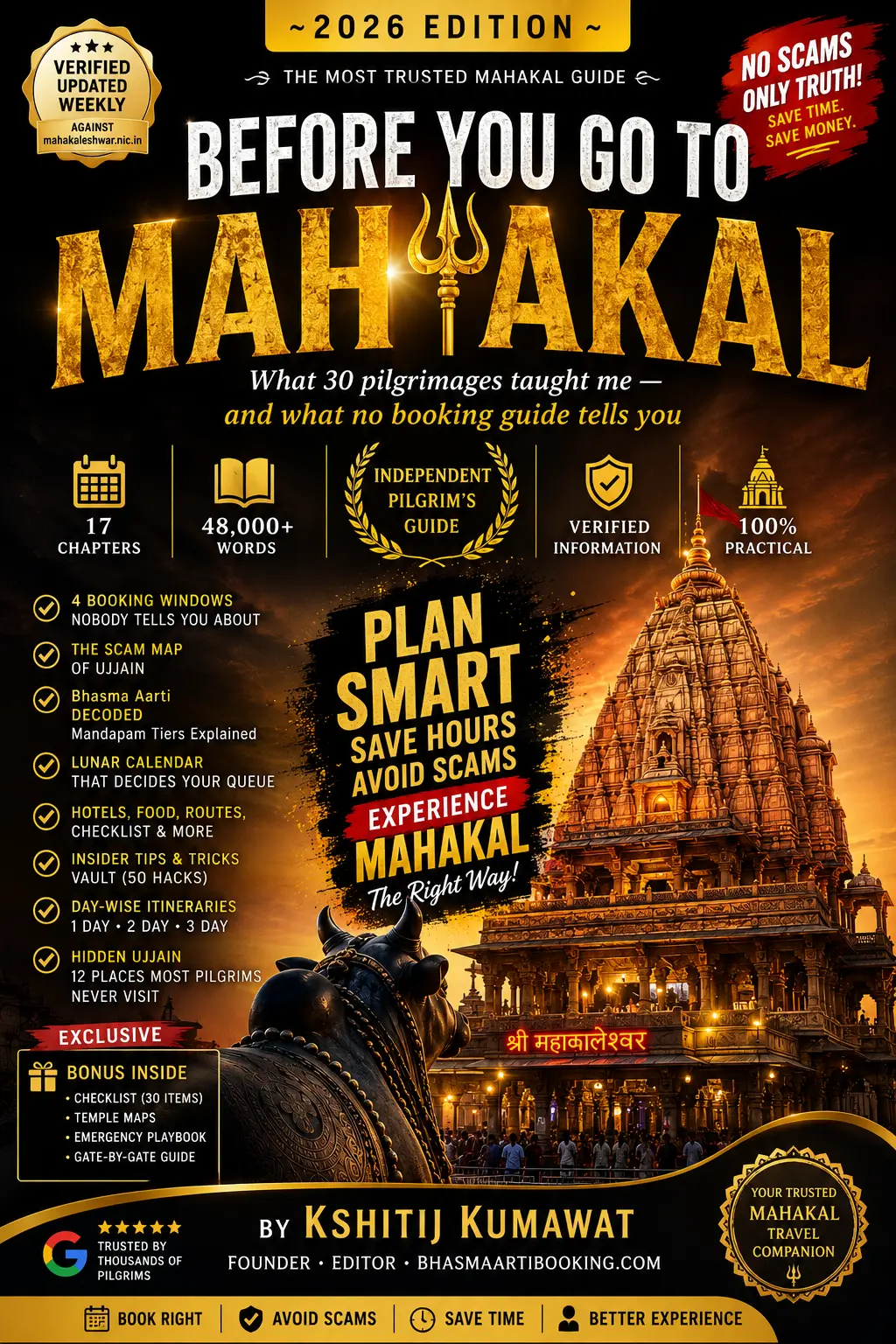
📕 120-Page PDF Guide
The Mahakal Devotee’s Insider Playbook
Self-help PDF guide to book Bhasma Aarti yourself · Mandapam tiers · Tithi calendar · Gate-by-gate map · Hotels & food · Day-trip itineraries · 17 chapters of insider know-how.
SAVE 85%
₹299₹2999
📩 Instant PDF on your email·📘 PDF guide — you book yourself·🔒 Razorpay secure·🔄 12-month free updates·🎯 Tested on 30+ pilgrimages
This guide covers everything: every major temple and its significance, darshan timings and ticket prices updated for 2026, the correct sequence for visiting, Bhasma Aarti booking guidance, dress codes, practical travel tips, and a complete one-day and two-day itinerary. Whether you have six hours or three days in Ujjain, this guide helps you experience the city’s spiritual depth in full.
Quick Answer — Featured Snippet
An Ujjain darshan tour covers Mahakaleshwar Jyotirlinga (open 4 AM – 11 PM), Kal Bhairav Temple (~4 km from Mahakaleshwar), Ram Ghat evening aarti, Harsiddhi Temple, Sandipani Ashram, and Mahakal Lok corridor. Quick darshan at Mahakaleshwar costs ₹250; Sugam darshan costs ₹300. Bhasma Aarti runs 4:00–6:00 AM and requires advance booking at mahakaleshwar.nic.in.
Table of Contents
- Why Ujjain Darshan Is Unlike Any Other Pilgrimage in India
- The Sacred Circuit of Ujjain — What to Cover
- Mahakaleshwar Temple — The Spiritual Heart of Ujjain
- Bhasma Aarti — The Most Sacred Pre-Dawn Ritual
- Mahakal Lok Corridor — The Grand New Addition
- Kal Bhairav Temple — The Fierce Guardian of Ujjain
- Ram Ghat and the Evening Shipra Aarti
- Harsiddhi Temple — The Shaktipeeth of Ujjain
- Sandipani Ashram — Where Lord Krishna Studied
- Mangalnath Temple — Birthplace of Planet Mars
- Bade Ganeshji Ka Mandir and Chintaman Ganesh Temple
- Gopal Mandir, Gadkalika Temple and Bhartrihari Caves
- Jantar Mantar (Vedh Shala) — Ujjain’s Astronomical Marvel
- Hidden and Offbeat Temples in Ujjain
- Mahakaleshwar Darshan Timings & Complete Aarti Schedule 2026
- Darshan Ticket Prices — All Types Explained
- Dress Code Rules for Ujjain Temple Darshan
- One-Day Ujjain Darshan Itinerary
- Two-Day Ujjain Darshan Itinerary
- Best Time to Visit Ujjain for Darshan
- Practical Tips for Ujjain Darshan Tour
- FAQs
- Conclusion
1. Why Ujjain Darshan Is Unlike Any Other Pilgrimage in India
Most Indian pilgrimage cities are defined by a single major temple. Ujjain is defined by its entire atmosphere. The temples and old streets of Ujjain are active parts of the city, not merely tourist attractions. Visiting these sites allows travelers to observe living traditions rather than only monuments from the past.
Several factors make an Ujjain darshan tour uniquely compelling:
Multiple Jyotirlinga Connection: Ujjain houses Mahakaleshwar — one of the 12 Jyotirlingas of Lord Shiva, and also the only south-facing (Dakshinamukhi) Jyotirlinga in the entire circuit. Ujjain is considered the Greenwich of India, with the first meridian of longitude passing through it — giving the city both cosmic and spiritual significance.
The Bhasma Aarti: No other active temple in India performs this ritual — a pre-dawn aarti using sacred ash, witnessed by a limited number of devotees in an atmosphere of extraordinary spiritual intensity.
Multi-tradition darshan: Ujjain’s temples honour Shiva, Shakti, Ganesha, Vishnu, and Navagrahas — making a complete Ujjain darshan tour a full encounter with the breadth of the Hindu tradition.
Living history: Ujjain is one of the oldest living cities in the world, known as Avantika in ancient times. It was an important political and cultural hub during the Mauryan and Gupta empires, and one of the Sapta Puri — the seven sacred cities of Hinduism — believed to grant salvation to devotees.
QUICK FACT Ujjain is renowned for hosting one of the largest religious gatherings in the world — the Simhastha Kumbh Mela — which occurs every 12 years on the banks of the Shipra River. The next Simhastha is expected around 2028, making 2026 an excellent time to visit before the city transforms under the scale of that event.
2. The Sacred Circuit of Ujjain — What to Cover
A complete Ujjain darshan tour ideally includes the following landmarks, organized by priority and category:
Essential Darshan (Must-Visit):
- Mahakaleshwar Jyotirlinga Temple + Bhasma Aarti
- Mahakal Lok Corridor
- Kal Bhairav Temple
- Ram Ghat (evening aarti)
- Harsiddhi Temple (Shaktipeeth)
- Bade Ganeshji Ka Mandir
High-Significance Darshan:
- Sandipani Ashram
- Mangalnath Temple
- Chintaman Ganesh Temple
- Gadkalika Temple
- Triveni Ghat / Navagraha Temple
Heritage and Cultural Landmarks:
- Jantar Mantar (Vedh Shala Observatory)
- Bhartrihari Caves
- Gopal Mandir
- Vikram Kirti Mandir Museum
For Extended Visits:
- Nagchandreshwar Temple (open only on Nag Panchami)
- ISKCON Temple Ujjain
- Kaliadeh Palace
- Bhartrihari Caves
3. Mahakaleshwar Temple — The Spiritual Heart of Ujjain
Every Ujjain darshan tour begins and ends at Mahakaleshwar. The heart and soul of Ujjain, the Mahakaleshwar Temple is one of India’s most powerful and revered Shiva shrines. The temple’s architecture beautifully blends Maratha, Bhumija, and Chalukya styles.
The Mahakal Lingam at this temple is believed to be Swayambhu (self-manifested), obtaining currents of Shakti from within itself. Mahakaleshwar is also one of the 18 Maha Shakti Peethas in India. This dual designation — as both a Jyotirlinga and a Shakti Peetha — makes it extraordinary among all Shiva temples.
What to do inside Mahakaleshwar Temple:
- Perform darshan of the Shiva Lingam in the underground sanctum (Garbh Grah)
- Walk the Mahakal Lok corridor before or after darshan
- Offer Jalabhishek or Rudrabhishek at the designated worship areas
- Visit Bade Ganeshji Ka Mandir at the entrance
- Collect Mahakal prasad (₹100 at designated counters)
Key fact: Ujjain’s Mahakaleshwar Temple typically welcomes 1.2 lakh devotees daily, with weekend crowds swelling to 1.5–1.75 lakh. Arriving early is not optional — it is essential.
IMPORTANT NOTE The shrine of Nagchandreshwar, located on the third floor of Mahakaleshwar Temple, is open for darshan only one day a year — on Nag Panchami. If your Ujjain darshan tour happens to fall on this day, attending this rare darshan is a once-in-a-year spiritual opportunity.
4. Bhasma Aarti — The Most Sacred Pre-Dawn Ritual
For many devotees, the Bhasma Aarti alone is the reason they travel to Ujjain. The Bhasma Aarti at Mahakaleshwar Temple takes place every morning from 4:00 AM to 6:00 AM. During this sacred ceremony, Lord Shiva is worshipped with holy ash (Bhasma), which symbolizes purification, letting go of worldly attachments, and spiritual awakening.
Bhasma Aarti is a unique ritual where sacred ash is offered to Lord Mahakal before sunrise. Unlike regular darshan, this ceremony happens inside the temple premises in a spiritually intense atmosphere filled with Vedic chants and traditional rituals.
Bhasma Aarti Timing:
- Starts: 4:00 AM daily
- Ends: Approximately 6:00 AM
- Reporting time: Reporting time is usually late night — around 12:30 AM to 2:00 AM. Late arrival may result in denied entry.
Bhasma Aarti Booking (2026):
Due to limited seating and strict entry regulations, Bhasma Aarti booking requires advance planning. Online registration slots fill quickly, especially during Shravan month, Mondays, Maha Shivaratri, and festival periods.
- Online: Book at mahakaleshwar.nic.in (official temple portal)
- Offline: Available at the authorized counter near the temple entrance, ideally a day before
Bhasma Aarti Dress Code (strictly enforced):
The Bhasma Aarti dress code is very strict. For men, dhoti is mandatory and the upper body must remain bare as per temple ritual tradition. Shirts, T-shirts, vests, and stitched upper garments are not permitted inside the aarti area. Women must wear saree.
Bhasma Aarti Ticket Price 2026:
| Ticket Type | Price |
| VIP / General Aarti | ₹200 per person |
| Bhasma Aarti + Garbh Grah Darshan Combo | ₹2,500 |
PRO TIP On auspicious dates like Shravan Somvar and Mahashivratri, Bhasma Aarti online booking slots fill within minutes of opening. Devotees often wait until midnight when the booking window opens 30 days in advance. Keep your documents ready and log in before the window opens.
5. Mahakal Lok Corridor — The Grand New Addition
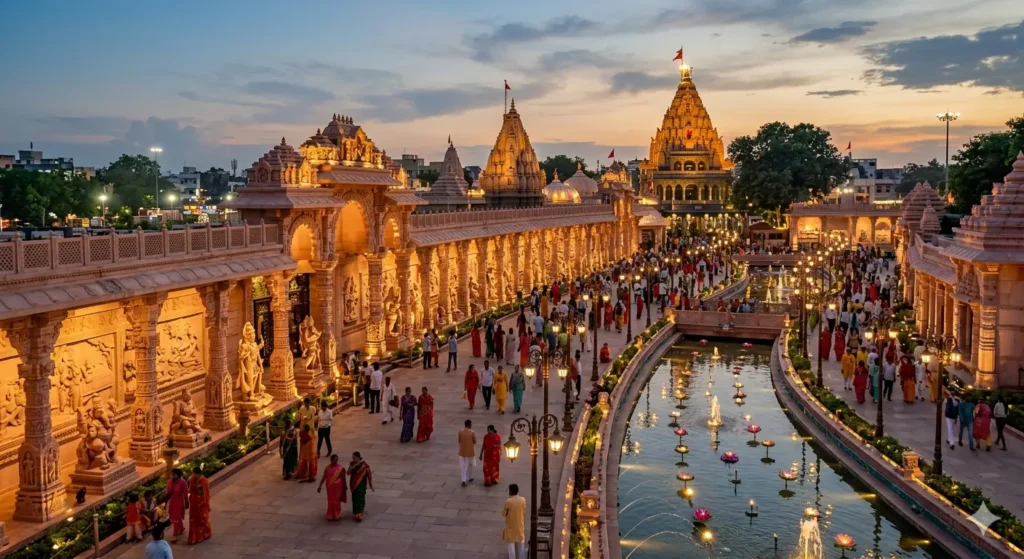
No Ujjain darshan tour in 2026 is complete without walking the Mahakal Lok corridor. The areas are now more organised; one can book online tickets in advance to skip long queues. One should consider staying in the premises longer, and if possible, in late evening, to enjoy the illuminated appearance of the Mahakal Lok passage.
Mahakal Lok in Ujjain is a grand corridor built around the revered Mahakaleshwar Temple. Spanning over 900 metres, it is adorned with intricately carved sandstone sculptures, murals, and ornamental pillars that narrate the glory of Lord Shiva and Ujjain’s historical legacy.
Best time to walk Mahakal Lok: Evening, when the entire corridor is illuminated and the sculptural panels glow with warm light. Allow 45–60 minutes for a complete, unhurried walk.
What to look for:
- Sculptural panels depicting Shiva’s cosmic legends from the Puranas
- The 108 pillars with intricate carvings
- The grand entry gate with the divine Tandava pose of Nataraja
- The Nandi statue at the corridor’s temple-facing end
QUICK FACT The Mahakal Lok corridor was inaugurated by Prime Minister Narendra Modi on October 11, 2022. It has since become one of the most photographed religious heritage projects in modern India, bringing a new dimension to what an Ujjain darshan tour means for the contemporary pilgrim.
6. Kal Bhairav Temple — The Fierce Guardian of Ujjain
It is believed that your Mahakaleshwar darshan is incomplete without Kal Bhairav darshan. This temple is located a little away from Mahakaleshwar Temple and you need to hire an auto or toto to reach there.
Shri Kaal Bhairav Temple in Ujjain is a revered spiritual destination dedicated to Kaal Bhairav, a fierce and powerful manifestation of Lord Shiva. Situated around 4 km from the city center, the temple holds immense religious significance and is deeply rooted in the practices of Shaivism and Tantra.
What makes Kal Bhairav unique:
The Kal Bhairav Temple is dedicated to one of the aggressive forms of Shiva, where devotees offer liquor as prasad. This is not a symbolic gesture — priests receive the offered bottle of liquor, place it at the deity’s lips, and it visibly disappears. This phenomenon, witnessed by thousands of devotees annually, remains one of the most extraordinary and unexplained occurrences at any Indian temple.
Practical notes:
- Distance from Mahakaleshwar: ~4 km
- Travel time by auto/toto: 10–15 minutes
- Liquor offering: Available from shops near the temple entrance (typically ₹20–₹60 per bottle)
- There is often a huge queue and it may take more than one hour for darshan. The ground outside is very rough — it is advisable to wear socks.
PRO TIP Visit Kal Bhairav between 8:00 AM and 10:00 AM on weekdays for the shortest queues. Avoid Saturdays — Bhairav’s sacred day — when crowds surge dramatically.
7. Ram Ghat and the Evening Shipra Aarti
Shri Ram Ghat, situated on the Kshipra River in Ujjain, is a revered and ancient site and one of the four locations for the Kumbh Mela held every 12 years. It holds immense religious importance, with millions of devotees gathering to take a holy dip believed to cleanse sins. The ghat is particularly enchanting during sunset.
Ram Ghat is a must-visit place in Ujjain. Visit in the evening to witness the Kshipra aarti along the banks of the holy river. The ghat is outlined with numerous temples, some of them also associated with the 84 Mahadev group of temples in Ujjain. You can also enjoy a boat ride by MPTDC.
Evening Aarti at Ram Ghat:
The evening Shipra aarti — performed at dusk — is a mesmerizing spectacle of synchronized lamp-waving, conch-blowing, and Vedic chanting. Priests perform the aarti on the main ghat platform while devotees float clay diyas on the river. This is Ujjain’s answer to Varanasi’s Ganga Aarti — equally powerful and significantly less crowded.
Best time: Arrive 30 minutes before sunset to find a comfortable viewing spot on the ghat steps.
Other activities at Ram Ghat:
- Take a morning dip in the Shipra (holy bath)
- Boat ride around the ghat area (MPTDC-operated)
- Visit Triveni Ghat and Navagraha Shani Mandir nearby
- Explore the small temples dotting the ghat promenade
IMPORTANT NOTE Sometimes the river water gets stagnant and gives a foul smell. Avoid visiting during monsoons as it gets flooded. The best time for Ram Ghat visits is October through March when the Shipra flows clean and the ghat atmosphere is at its finest.
8. Harsiddhi Temple — The Shaktipeeth of Ujjain
The Shree Harsiddhi Mata Shaktipeeth Temple in Ujjain is a revered site of spiritual significance and one of the 51 Shaktipeethas spread across the Indian subcontinent. Situated near the Mahakaleshwar Temple, it holds immense religious importance for devotees of Goddess Shakti.
According to Hindu mythology, the elbow of Goddess Sati fell here during the divine episode that created the 51 Shakti Peethas. The presiding deity is Goddess Annapurna, flanked by Mahalakshmi and Mahasaraswati.
Highlights:
- Twin oil-lamp columns (deepmala) at the entrance that hold hundreds of diyas — during Navratri, all are lit simultaneously, creating an otherworldly spectacle
- The idol of Goddess Harsiddhi in a deep crimson hue
- Close proximity to Mahakaleshwar — easily combined in the same morning visit
QUICK FACT The Harsiddhi Temple is illuminated with thousands of diyas during Navratri. If your Ujjain darshan tour falls during the Navratri festival period (typically September–October), the Harsiddhi Temple experience reaches an entirely different level of spiritual intensity.
9. Sandipani Ashram — Where Lord Krishna Studied
Legend has it that Lord Krishna did his schooling from Sandipani Ashram in Ujjain. This ancient site is one of Ujjain’s most historically significant — and most peacefully atmospheric — landmarks.
Maharishi Sandipani Ashram in Ujjain is a revered site with deep historical and spiritual significance. According to the Bhagavata Purana, Lord Krishna, his brother Balaram, and his friend Sudama all received their education at this ashram under Guru Sandipani — covering the 64 arts (Chausath Kalas) in just 64 days.
What to see at Sandipani Ashram:
- The original kund (sacred pond) where Krishna is said to have learned
- Ancient stone slabs with numbers inscribed — believed to be the original slate used for teaching
- A large marble idol of Lord Krishna with Balaram and Sudama
- The peaceful garden and meditation space
Distance from Mahakaleshwar: ~3–4 km
Best visited: Morning, when the ashram is quiet and devotees are fewer.
10. Mangalnath Temple — Birthplace of Planet Mars
The Mangalnath Temple is believed to be the birthplace of planet Mars, holding astrological importance. This temple occupies a unique position at the intersection of Hindu religious tradition and Vedic astrology.
Ujjain is considered the Greenwich of India, with the first meridian of longitude passing through it. This astronomical significance makes Mangalnath Temple — dedicated to Mangal (Mars) — doubly meaningful. Astrologers and devotees from across India visit specifically for Mangal Dosh puja and related Vedic remedies.
Who should visit: Anyone with Mangal (Mars) placements requiring ritual correction in their horoscope, or those with Manglik dosha in their kundali. Also highly recommended for Aries and Scorpio natives.
Pooja timings: Specific Mangalnath puja schedules align with the temple’s daily ritual calendar — arriving before 9:00 AM ensures participation in the morning puja sequence.
11. Bade Ganeshji Ka Mandir and Chintaman Ganesh Temple
Bade Ganeshji Ka Mandir: Located at the entrance of the Mahakaleshwar Temple complex, this temple houses one of the largest Ganesha idols in Madhya Pradesh. Every Ujjain darshan tour traditionally begins with Ganesha darshan before proceeding to Mahakaleshwar — following the principle of seeking Ganesh’s blessings before any auspicious undertaking.
Chintaman Ganesh Temple: An ancient Chintaman Ganesh Temple known for its self-manifested idol of Lord Ganesh. “Chintaman” literally means “wish-fulfilling” — devotees visit to pray for the removal of worries and grant of desires. The temple is peaceful, less crowded than the Mahakaleshwar complex, and particularly beautiful in the early morning light.
PRO TIP Visiting both Ganesh temples on the same darshan tour creates a complete Ganesha circuit within Ujjain. Bade Ganeshji is at Mahakaleshwar Temple entrance (easy to combine), while Chintaman Ganesh is ~3 km away and easily included on the route to Sandipani Ashram.
12. Gopal Mandir, Gadkalika Temple, and Bhartrihari Caves
Gopal Mandir: A glorious example of Maratha architecture, the Gopal Mandir is a marble-towered structure dedicated to Lord Krishna. Situated in the heart of Ujjain’s main market square, it is one of the most architecturally impressive temples in the city. Visit on your way between the city centre and the railway station area.
Gadkalika Temple: The spiritually significant Gadkalika Mandir is linked to poet Kalidasa. According to tradition, the legendary Sanskrit poet Kalidasa — whose works include Meghaduta and Abhijnanasakuntalam — worshipped Goddess Gadkalika here and received divine literary inspiration. The temple is dedicated to an incarnation of Goddess Kali and holds deep Tantric significance.
Bhartrihari Caves: Bhartrihari Caves, located about 6 kilometres from the city centre of Ujjain, are an important historical and spiritual site. Associated with the legendary poet-king Bhartrihari — who renounced his throne and retreated to these caves — the site is one of remarkable natural and spiritual peace. The sound of bats, the darkness of the cave passages, and the ancient inscriptions on the walls create an otherworldly experience.
13. Jantar Mantar (Vedh Shala) — Ujjain’s Astronomical Marvel
Jantar Mantar in Ujjain, also known as the Vedh Shala Observatory, is an architectural and scientific marvel built in the 18th century by Maharaja Jai Singh II, making it one of the oldest among the five Jantar Mantars in India — alongside Jaipur, Delhi, Mathura, and Varanasi. Situated near the Dashashwamedh Ghat, this observatory reflects India’s rich heritage in astronomy and mathematics.
While not a temple, Vedh Shala is deeply intertwined with Ujjain’s identity as the ancient prime meridian of Indian astronomy. The instruments here — including a massive sundial, celestial globes, and horizon instruments — still function accurately.
Why include it in your darshan tour: The connection between Ujjain’s astronomical significance and its spiritual importance is profound. Ancient Hindu calendars (Panchangs) still use Ujjain as their reference point for calculating planetary positions and auspicious timings.
Entry fee: Nominal charge (₹10–₹30)
Best time to visit: Mid-morning, when the light creates clear shadows on the astronomical instruments.
14. Hidden and Offbeat Temples in Ujjain
Beyond the main circuit, Ujjain holds dozens of significant but less-visited temples worth including on an extended darshan tour:
Triveni Ghat and Navagraha Shani Mandir: The Shri Ram Ghat is the most ancient bathing ghat, and Triveni Ghat nearby is where three sacred streams are said to meet. The Navagraha temple here is particularly significant for astrological remedies.
ISKCON Temple Ujjain: The ISKCON Temple in Ujjain, also known as Shri Radha Madhan Mohan Mandir, is a prominent spiritual and cultural landmark near the Nanakheda area — a hub of devotion, education, and service dedicated to Lord Krishna and Radha.
Chaubis Khamba Temple: The Shri Chaubis Khamba Mata Temple is situated on a hilltop and dedicated to Goddess Chaubis Khamba Mata — a powerful deity believed to protect her devotees from all obstacles. The hilltop setting offers one of the better elevated views of the city.
84 Mahadev Temples Circuit: Ujjain contains 84 ancient Mahadev shrines distributed across the city and its surrounding villages. Completing this circuit — known as the Chaurasi Mahadev Yatra — is considered one of the most complete forms of Ujjain darshan, typically spread over several days.
15. Mahakaleshwar Darshan Timings & Complete Aarti Schedule 2026
The temple opens at 4:00 AM and closes at 11:00 PM, with multiple darshan slots throughout the day.
Full Daily Aarti and Darshan Schedule:
| Ritual / Darshan | Timing (Summer) | Timing (Winter) |
| Bhasma Aarti (Pre-Dawn) | 4:00 AM – 6:00 AM | 4:00 AM – 6:00 AM |
| Morning Darshan Opens | 7:00 AM | 7:00 AM |
| Bhog Aarti | 10:00 AM | 10:30 AM |
| Afternoon Darshan | 10:30 AM – 5:00 PM | 10:30 AM – 5:30 PM |
| Sandhya Puja | 5:00 PM | 5:30 PM |
| Sandhya Aarti | 7:00 PM | 7:30 PM |
| Shayan Aarti | 10:30 PM | 10:30 PM |
| Temple Closes | 11:00 PM | 11:00 PM |
Recommended visiting windows: Early Morning (4:00 AM – 6:00 AM) for Bhasma Aarti and calm spiritual ambiance. During Sawan Month, Nag Panchami, and Mahashivratri, Garbh Grah entry may be limited due to heavy crowds.
Sandhya Aarti and Shayan Aarti Online Booking:
The Mahakaleshwar Temple management has implemented a fully digital booking system for Sandhya Aarti (Evening Aarti) and Shayan Aarti (Night Aarti) through the official portal at shrimahakaleshwar.mp.gov.in. Ticket price: ₹250 per devotee. Online reservation for Sandhya Aarti opens every day at 12:00 PM; for Shayan Aarti, online booking starts daily at 4:00 PM.
16. Darshan Ticket Prices — All Types Explained (2026)
| Darshan Type | Price | Notes |
| General Darshan | Free | Entry through Mansarovar Gate; may involve long queue |
| Quick / Sugam Darshan | ₹250 – ₹300 | Faster entry; accompanied by Shastri escort |
| Garbh Grah Darshan (Single) | ₹750 | Inner sanctum access |
| Garbh Grah Darshan (Couple) | ₹1,999 | Inner sanctum; both devotees |
| Bhasma Aarti (VIP) | ₹200 per person | Pre-dawn aarti; must book in advance |
| Bhasma Aarti + Garbh Grah Combo | ₹2,500 | Full package; premium spiritual experience |
| Sandhya Aarti | ₹250 per person | Evening aarti; online booking from 12 PM daily |
| Shayan Aarti | ₹250 per person | Night aarti; online booking from 4 PM daily |
The Sugam darshan currently costs ₹300 per person and is accompanied by a Shastri escort for guided access to the sanctum. The temple also offers daily rituals including Mangla Aarti (₹500), Mid-day Bhog Aarti (₹300), Saptarishi Aarti (₹300), Shringaar Aarti (₹300), and Rudrabhishek ranging from ₹450 to ₹2,600 depending on the number of priests involved.
COMMON MISTAKE Many devotees arrive expecting to walk in for Bhasma Aarti without a pass and are turned away at the gate. Booking (online or offline) is mandatory as the seating is limited. You cannot attend the Bhasma Aarti without prior booking.
17. Dress Code Rules for Ujjain Temple Darshan
Different temples in Ujjain apply different dress standards. Here is a consolidated guide:
For Bhasma Aarti (strictest dress code):
Men should wear dhoti or sleeveless vest; women should wear saree or salwar-kameez. Avoid carrying mobile phones, leather items, or handbags inside.
For Garbh Grah Darshan (inner sanctum):
Dress code: Avoid shorts and sleeveless tops. Men wear dhoti and women wear saree for Garbh Grah Darshan.
For General Darshan at all Ujjain temples:
- Wear modest clothing — no shorts, skirts above the knee, sleeveless tops, or revealing garments
- Remove footwear before entering any temple premises
- Avoid leather items inside sacred areas
- Women should carry a dupatta or stole to cover the head in the inner sanctum if required
- No non-vegetarian food or alcohol within temple premises (except as prasad at Kal Bhairav)
General Rules Across Ujjain Temples:
Entry into Garbh Grah is only for Hindu devotees. Carry a valid photo ID along with your e-ticket. Arrive at least 30 minutes early for your time slot.
IMPORTANT NOTE Deposit your mobile phone and footwear at the designated counters before entering Mahakaleshwar Temple. Mobile phones and footwear must be deposited before entry. Paid locker facilities are available near the main gate — use them, as holding your phone during the crowded darshan queue is impractical and against temple rules.
18. One-Day Ujjain Darshan Itinerary
This itinerary is designed for a visitor spending one full day in Ujjain, starting with Bhasma Aarti and covering all essential darshan sites.
| Time | Activity | Notes |
| 1:00 AM – 2:00 AM | Report at Mahakaleshwar Temple | Carry Bhasma Aarti pass and ID |
| 4:00 AM – 6:00 AM | Bhasma Aarti | Pre-booked; follow dress code strictly |
| 6:00 AM – 7:00 AM | Morning Shipra snan at Ram Ghat | Walk 5 min from temple; sunrise view |
| 7:00 AM – 8:00 AM | Breakfast near Mahakal Chowk | Local poha-jalebi breakfast |
| 8:30 AM – 10:30 AM | Mahakaleshwar main darshan + Mahakal Lok corridor | Allow 2 hours; VIP darshan Read the complete mahakal vip darshan booking guide for 2026 booking steps, tier-wise prices and insider tips.if pre-booked |
| 10:45 AM – 11:30 AM | Harsiddhi Temple | Adjacent to Mahakaleshwar; 45 min |
| 11:45 AM – 12:30 PM | Bade Ganeshji Ka Mandir + Kal Bhairav Temple | Auto/toto to Kal Bhairav (15 min) |
| 12:30 PM – 1:30 PM | Lunch break | Vegetarian thali near temple area |
| 2:00 PM – 3:00 PM | Sandipani Ashram | 30–45 min visit; peaceful setting |
| 3:15 PM – 4:00 PM | Mangalnath Temple | Astrological significance |
| 4:15 PM – 5:00 PM | Jantar Mantar / Vedh Shala | Science-spirituality intersection |
| 5:30 PM – 7:30 PM | Ram Ghat evening aarti | Arrive early for good ghat position |
| 8:00 PM | Dinner and rest | Return to hotel |
PRO TIP This itinerary assumes a pre-booked Bhasma Aarti pass. If Bhasma Aarti is not on your plan, start at 7:00 AM at Mahakaleshwar for peaceful morning darshan, walk the Mahakal Lok corridor in the morning, and redistribute the remaining time comfortably — ending with the evening Sandhya Aarti at Mahakaleshwar (7:00 PM) followed by Ram Ghat.
19. Two-Day Ujjain Darshan Itinerary
For pilgrims who wish to cover Ujjain thoroughly — including the 84 Mahadev circuit highlights, hidden temples, and an optional day trip to Omkareshwar.
Day 1 — Core Darshan Circuit
Follow the one-day itinerary above. Include the evening Shayan Aarti at Mahakaleshwar (10:30 PM) if stamina allows — it is a rare and serene experience to witness Lord Mahakal being put to ceremonial rest.
Day 2 — Deeper Ujjain and Day Trip Option
| Time | Activity |
| 6:00 AM | Morning walk and Shipra snan at Triveni Ghat |
| 7:30 AM | Chintaman Ganesh Temple (self-manifested Ganesh) |
| 8:30 AM | Gopal Mandir (Maratha marble architecture) |
| 9:30 AM | Gadkalika Temple (Kalidasa’s inspiration) |
| 10:30 AM | Bhartrihari Caves (poet-king’s retreat) |
| 12:00 PM | Vikram Kirti Mandir Museum (King Vikramaditya heritage) |
| 1:00 PM | Lunch |
| 2:30 PM – 6:00 PM | Optional: Day trip to Kaliadeh Palace (seasonal) or ISKCON Temple |
| 7:00 PM | Sandhya Aarti at Mahakaleshwar |
| 8:30 PM | Mahakal Lok evening walk (illuminated) |
Optional Day 3 — Omkareshwar Jyotirlinga Day Trip
Depart Ujjain by cab at 5:00 AM. Reach Omkareshwar by 8:30 AM. Perform darshan at Mamleshwar and Omkareshwar Jyotirlinga, take Narmada snan, do boat parikrama, and return to Ujjain by evening. Covering both Jyotirlingas on consecutive days is considered among the most auspicious Shiva darshan circuits in India.
20. Best Time to Visit Ujjain for Darshan
| Season | Months | Temperature | Darshan Experience |
| Best Season | October – March | 10°C – 28°C | Ideal; comfortable weather; pleasant ghats |
| Mahashivratri | February 15, 2026 | Cool | Peak spiritual energy; massive crowds |
| Shravan Month | July – August | Humid, 28–35°C | Extremely auspicious; very heavy crowds |
| Summer | April – June | 35°C – 45°C | Manageable with early departures |
| Monsoon | July – September | Humid, rain | Avoid if possible; river flooding risk |
The tranquil and calm experience of witnessing the glorious temples and shrines at the bank of the Shipra river is incredible. This experience is best in the cooler months between October and February when the Shipra flows cleanly and the ghats glow under pleasant skies.
Festival periods for elevated spiritual merit:
- Mahashivratri (February 15, 2026): Largest single-day crowd at Mahakaleshwar; Bhasma Aarti books out months in advance; extraordinary spiritual atmosphere
- Shravan Somvar (every Monday in July–August): During the sacred month of Sawan, devotees of Lord Shiva gather in Ujjain for the grand Mahakal Sawari procession, held every Monday, beginning at the Mahakaleshwar Temple and winding through the city amidst rhythmic drum beats and chants.
- Navratri: Harsiddhi Temple and Gadkalika Temple reach peak spiritual intensity
- Kartik Poornima: Ram Ghat and Shipra snan is considered especially auspicious
21. Practical Tips for Ujjain Darshan Tour
Plan temple sequence by geography: Start at Mahakaleshwar Temple and plan your route outward. Harsiddhi Temple is adjacent. Kal Bhairav is 4 km north. Sandipani Ashram is 3–4 km northwest. Mangalnath is southwest. Chintaman Ganesh is northwest of the railway station. A good driver will sequence these to minimize backtracking.
Book all passes before arriving: Bhasma Aarti, Garbh Grah darshan, Sandhya Aarti, and Shayan Aarti all have online booking at mahakaleshwar.nic.in. Booking these in advance — especially Bhasma Aarti — is non-negotiable for peak periods.
Carry a printed copy of all bookings: Booking confirmation must exactly match the ID proof carried on the visit day. Print both your booking confirmation and carry your original government ID — Aadhaar, Voter Card, or Passport.
Deposit phone and valuables: Use the paid lockers near the Mansarovar Gate. Do not carry valuables into the inner temple areas — the crowd inside the sanctum is dense and pickpockets operate in religious sites everywhere.
Wear socks for Kal Bhairav: The ground outside Kal Bhairav Temple is very rough and it is not easy to walk barefoot — wearing socks is advisable.
Use autos and totos within the city: The narrow lanes around Mahakaleshwar cannot accommodate cars. For movement between temples, electric totos and shared autos are the most practical option.
Stay hydrated: Ujjain’s temple circuit involves considerable walking, queue-standing, and early morning activity. Carry a water bottle — especially important in summer months when temple forecourts can become very hot by mid-morning.
IMPORTANT NOTE During major festival periods, police arrange additional parking outside the city due to full capacity within. If arriving by car during Mahashivratri or Shravan Somvar, use the designated external parking zones and take shuttle transport to the temple — attempting to drive to the temple area during peak crowds leads to hours of congestion.
Recommended Reading: Complete Guide to Bhasma Aarti Booking at Mahakaleshwar Temple
The Bhasma Aarti is the centrepiece of any Ujjain darshan tour. Our complete Bhasma Aarti booking guide covers the step-by-step online registration process, all ticket categories, dress code requirements, what to expect on the morning of the aarti, and tips for attending without stress — all updated for 2026.
Conclusion
An Ujjain darshan tour is not something you simply do — it is something that happens to you. The city works on you at its own pace. The pre-dawn darkness of Bhasma Aarti, the intoxicating sound of temple bells echoing off ancient stone, the sight of diyas floating down the Shipra at dusk, the fierce gaze of Kal Bhairav above a silver crown, the serene grove of Sandipani Ashram where legends say a young Krishna once bent over his studies — these are not experiences that follow from an itinerary. They arrive in their own time, in proportion to your readiness to receive them.
What this guide gives you is the preparation that makes that reception possible. Knowing your Bhasma Aarti reporting time, your darshan ticket category, the correct sequence of temples, what to wear and what to carry — all of this allows you to arrive at each sacred threshold without distraction, fully present in the moment.
Ujjain’s darshan circuit covers more than temples. It covers traditions thousands of years deep, astronomical heritage that predates modern science, and a living daily devotion that millions of people maintain not as an obligation but as an expression of love for a city that is, in every meaningful sense, the dwelling place of Mahakal — Lord of Time.
Plan your Ujjain darshan tour with care. Arrive with reverence. The rest, the city will provide.
For Bhasma Aarti booking and complete Ujjain pilgrimage planning, visit bhasmaartibooking.com.
Frequently Asked Questions about Ujjain Mahakal darshan
10 verified answers compiled by Kshitij Kumawat from the official Shri Mahakaleshwar Temple Trust portal at mahakaleshwar.nic.in. Last updated 2026-05-07. We do not facilitate bookings.
How do I book Ujjain Mahakal darshan on the official temple site?
Visit mahakaleshwar.nic.in, log in, click the relevant Ujjain Mahakal darshan option from the menu, choose date and devotee details, and pay with UPI or card. We do not handle Ujjain Mahakal darshan bookings.
What is the 2026 ticket price for Ujjain Mahakal darshan?
Ujjain Mahakal darshan pricing is set by the Shri Mahakaleshwar Temple Trust. Free general access, paid passes 250 to 3,000 rupees, Garbh Grah 750 rupees. Verify on mahakaleshwar.nic.in before payment.
How early should I reach the temple for Ujjain Mahakal darshan?
For 4 AM Bhasma Aarti reach Gate 4 by 3 AM. For daytime VIP or general darshan reach 30 to 60 minutes before your slot. For festival days connected to Ujjain Mahakal darshan add 90 minutes buffer.
What is the dress code when attending Ujjain Mahakal darshan?
Men: dhoti or full pants with shirt. Women: saree or salwar suit with full sleeves and dupatta. No jeans, shorts, sleeveless or Western wear. Ujjain Mahakal darshan follows the standard Bhasma Aarti dress code.
Are there scams I should watch for around Ujjain Mahakal darshan?
Yes. Touts at Gate 1 sell fake passes for 1,000-5,000 rupees. WhatsApp groups promise guaranteed slots. Hotel concierges add 2,000 rupee markups. Pay only on mahakaleshwar.nic.in.
Can I bring my mobile phone during Ujjain Mahakal darshan?
Mobile phones are deposited at security locker before entering the sanctum or Bhasma Aarti hall. The corridor outside permits photos. Ujjain Mahakal darshan inside the inner sanctum is no-phone.
Can children attend Ujjain Mahakal darshan?
Children under 5 enter free with adult. Above 5 need their own pass at the same price. Ujjain Mahakal darshan suits kids who can sit quietly. Bring water and snacks for early morning slots.
What documents are required for Ujjain Mahakal darshan?
Original Aadhaar or PAN of every devotee. The QR ticket PDF (printed or on phone). Photocopies and digital images of ID are rejected. Ujjain Mahakal darshan verification happens at the gate.
Is photography allowed during Ujjain Mahakal darshan?
Photography is prohibited inside the sanctum and Bhasma Aarti hall. The Mahakal Lok corridor and outside gate areas allow photos. Ujjain Mahakal darshan ritual photography requires written permission.
Are refunds available for Ujjain Mahakal darshan cancellations?
No refunds. Bookings can be rescheduled to a future date by contacting the temple office at least 48 hours before. Same-day no-shows lose the pass.

About this site
Independent informational guide for Mahakal Bhasma Aarti at Mahakaleshwar Temple, Ujjain. Verified weekly against the official portal mahakaleshwar.nic.in. We do not facilitate bookings.
Bhasma Aarti
Mahakal Darshan
Plan your trip

Kshitij Kumawat
Built this site to protect devotees from scams. 30+ Bhasma Aarti visits since 2018.