


Written by Kshitij Kumawat · Ujjain local, documenting Mahakaleshwar since 2018
Independent guide — kept up to date and verified against the official temple portal www.shrimahakaleshwar.mp.gov.in
Key Highlights: Every God Faces East or North. Mahakal Faces South
- Mahakaleshwar Temple: Ujjain, MP. One of 12 Jyotirlingas. Open 3 AM to 11 PM daily.
- Bhasma Aarti: 4 AM daily ash-anointing ritual. Paid pass 1,500 to 3,000 rupees.
- Booking: Only on official www.shrimahakaleshwar.mp.gov.in. 60-day advance window.
- Disclaimer: We do not facilitate bookings. Beware of fake agents charging extra.
Walk into any Hindu temple in India and notice which way the main deity faces.
East — the direction of the rising sun, of new beginnings, of life.
North — the direction of Mount Meru, the cosmic axis, the abode of the gods.
You will almost never see a major deity facing south. In Hindu tradition, south is the direction of Yama — the God of Death. It is the direction of endings, of the realm of the dead, of forces that human beings are meant to face as rarely as possible.
There are strict rules in Vastu Shastra (the ancient science of spatial arrangement) about this. Temples should not face south. Deities should not face south. The door to your bedroom should not face south.
And yet.
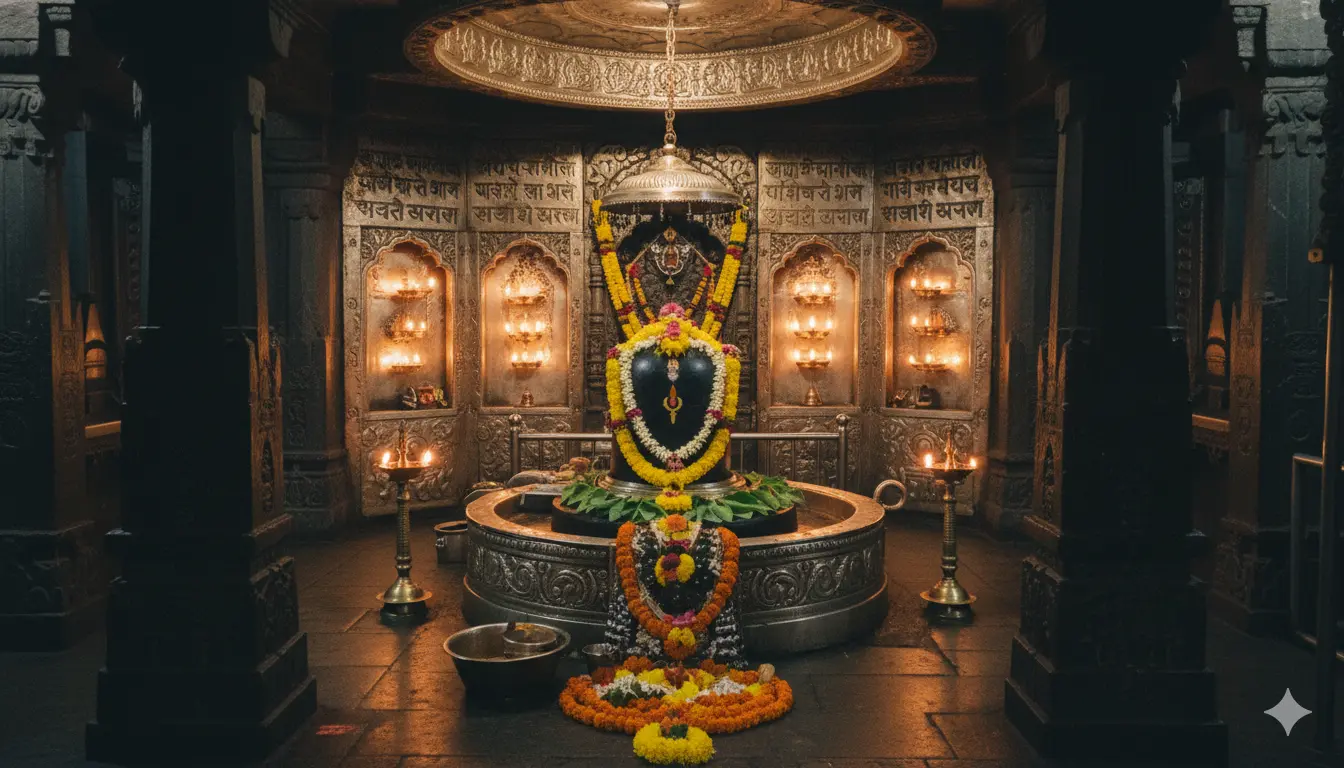
In Ujjain, in the innermost sanctum of Mahakaleshwar Temple, the most sacred Shivalinga in the world faces precisely south.
Directly, deliberately, defiantly south.
And the reason — when you understand it — reveals the true identity of Lord Mahakal in a way that nothing else does.
The Rule That Mahakal Breaks
In Hindu cosmology and Vastu tradition, the eight directions each carry a divine association:
- East: Indra (King of Gods)
- West: Varuna (God of Water/Order)
- North: Kubera (God of Wealth)
- South: Yama (God of Death)
- Northeast: Ishana (Auspicious)
- Northwest: Vayu (Wind)
- Southeast: Agni (Fire)
- Southwest: Nirriti (Chaos/Destruction)
South is Yama’s domain. Death’s door. The direction that inauspiciousness enters from. This is why in traditional Indian homes, you are advised not to sleep with your head pointing south — you are pointing yourself toward death’s domain.
For a temple — a place of divine presence, of life energy, of blessing — to face south is almost unthinkable. Temple architects throughout Indian history have gone to great lengths to ensure east-facing or north-facing entrances and idols.
But Mahakaleshwar faces south. Not by accident. Not as a mistake or limitation of geography. It was built this way intentionally, and the reason is encoded in the very name of the deity.
Mahakal: The One Who Has Already Conquered Death
“Mahakal” does not merely mean “Great God.” It means the Great Time — but more specifically, it means the one who has conquered Time and Death.
In Sanskrit, “Kaal” has a dual meaning: it means both “Time” and “Death.” They are the same word because they are, philosophically, the same force. Time is what kills everything. Death is time made final.
Mahakal — Maha Kaal — is the deity who stands above and beyond both. He is not subject to time. He is not subject to death. He is the master of the force that destroys everything else — a truth explored in the 2,000-year rule that even kings obeyed.
Now consider: if you are the conqueror of death, what do you do? You face it. You look directly at it. You do not turn away.
When the Mahakaleshwar Shivalinga faces south — when it faces directly into the domain of Yama, the God of Death — it is making a theological statement that is as clear as it is awe-inspiring:
I am not afraid of you. I am your master.
The Only Dakshina-Murti Jyotirlinga
“Dakshina” means south in Sanskrit. “Dakshina-Murti” means south-facing form. Lord Shiva does have a specific south-facing form — Dakshinamurthy — who is the teacher, the guru, the one who imparts wisdom while facing south. Dakshinamurthy faces his students who face north to receive his teachings.
Mahakaleshwar as a Jyotirlinga takes this to a cosmic level. The Swayambhu (self-manifested) linga facing south is not merely a guru posture — it is the supreme deity staring down death itself, permanently, as an eternal statement of his nature.
In all 12 Jyotirlingas, this occurs only once. Every other Jyotirlinga maintains conventional directional orientation. Mahakaleshwar alone faces south.
This uniqueness is one of the reasons why, among the 12, Mahakaleshwar is given supreme status in many scriptural hierarchies. He is the one who does what no other deity does. He confronts what all others avoid.
The Underground Garbhagriha: Another Break From Convention
The south-facing orientation is not the only architectural anomaly at Mahakaleshwar. The main Garbhagriha — the inner sanctum housing the Shivalinga — is located underground. You descend steps to reach it.
Most major Hindu temples have their Garbhagriha at ground level or elevated. Descending underground to reach the deity is a specific reference to the Swayambhu nature of the linga — it emerged from the earth, from below the surface, from the depths.
Underground. Facing south. The God of Time dwelling in the direction and the depth of death.
These are not coincidences of architecture. They are a complete cosmological statement built in stone over two thousand years ago.
What This Means for Devotees
When you stand in the Garbhagriha at Mahakaleshwar — underground, facing the south-facing linga, at 4 AM during the Bhasma Aarti with the scent of cremation ash in the air — you are not in a typical temple.
You are standing at the intersection of life and death, facing the deity who masters both.
The Bhasma — the ash — on the linga is not a coincidental ritual element. Ash is what everything becomes. It is death made tangible. And it is placed on Mahakal every single morning as an act of worship.
Ash on a south-facing underground god. Life worshipping death.
That is Ujjain. That is Mahakal.
The Teacher Who Faces South
There is a second way to read Mahakal’s southern gaze, and it comes from one of the most beloved images in the Shaiva world. In temples across South India, Shiva appears as Dakshinamurti — the young teacher seated beneath a banyan tree, facing south, instructing aged sages in perfect silence. In that form, south is not the direction of threat. It is the direction a teacher deliberately turns toward, because that is where the students sit — and because the hardest lesson of all, the lesson about endings, must be taught facing the direction of endings.
Mahakal facing south, then, is not only a conqueror holding a captured direction. He is a teacher holding a classroom. The silent instruction is the same one Dakshinamurti gives beneath the banyan: death is not an interruption of life but its frame, and the one who understands the frame stops being afraid of the picture.
This is why prayers at Mahakaleshwar so often concern fear itself. Devotees come here for protection from untimely death, for courage before surgeries and verdicts, for steadiness in grief — the specific anxieties that live in the southern direction of the mind. Other shrines answer prayers for wealth and progeny; Ujjain’s south-facing lord specializes in the prayer that sits beneath all of them: let me not be afraid. Ask the pandits on the temple lane what people whisper at this sanctum, and the answers circle the same theme — not gain, but fearlessness.
A City That Never Learned to Look Away
Ujjain built itself around this axis. The old legend of cremation-ground ash in the morning aarti. Kal Bhairav, the fierce guardian at the city’s edge, accepting offerings no other deity accepts. A sanctum sunk below ground level, entered by descending rather than ascending. Where most sacred cities specialize in auspicious beginnings — births, weddings, new ventures — Ujjain specializes in the truth about endings, and it has never apologized for it.
The paradox every pilgrim reports is that this city of death is not a heavy place. People leave Ujjain feeling lighter, not darker. Face the fact of mortality once, in front of the one being said to be beyond it, and the fact loses much of its weight. That is the entire curriculum, and the south-facing linga is its blackboard.
Facing the South-Facing God
Geometry does something quiet to you in the garbhagriha. Because Mahakal faces south, you stand to his south and look north as you take darshan — which means you stand in Yama’s direction, looking toward the god who is said to command him. Devotees who know the tradition say this is the whole point of coming: for one moment, you stand where death stands, and find Mahakal between you and it.
The statement is at its fullest during the Bhasma Aarti, when ash — the residue of all endings — is offered to the south-facing lord at 4:00 AM. Passes cost around ₹200 and are issued only through the temple’s official portal; our Bhasma Aarti booking guide covers the process step by step, and current darshan windows are listed in the Mahakal darshan timings guide.
The Direction of Fearlessness
Vastu Shastra is not wrong to treat the south with caution — for houses, for doorways, for the living. But Mahakaleshwar was never built for caution. It was built as the one address in the Hindu world where the rule could be broken on purpose, by the only one entitled to break it. Every other temple protects you from the south. This one turns you around, stands you in it, and shows you there was never anything there to fear. That, in the end, is the gift of the broken rule: a billion doorways in India face away from death, and one faces it — so that at least once in a lifetime, a devotee can stand behind the only being for whom the gateway of death is merely a view.