
Walk into any Hindu temple in India and notice which way the main deity faces.
East — the direction of the rising sun, of new beginnings, of life.
North — the direction of Mount Meru, the cosmic axis, the abode of the gods.
You will almost never see a major deity facing south. In Hindu tradition, south is the direction of Yama — the God of Death. It is the direction of endings, of the realm of the dead, of forces that human beings are meant to face as rarely as possible.
There are strict rules in Vastu Shastra (the ancient science of spatial arrangement) about this. Temples should not face south. Deities should not face south. The door to your bedroom should not face south.
And yet.
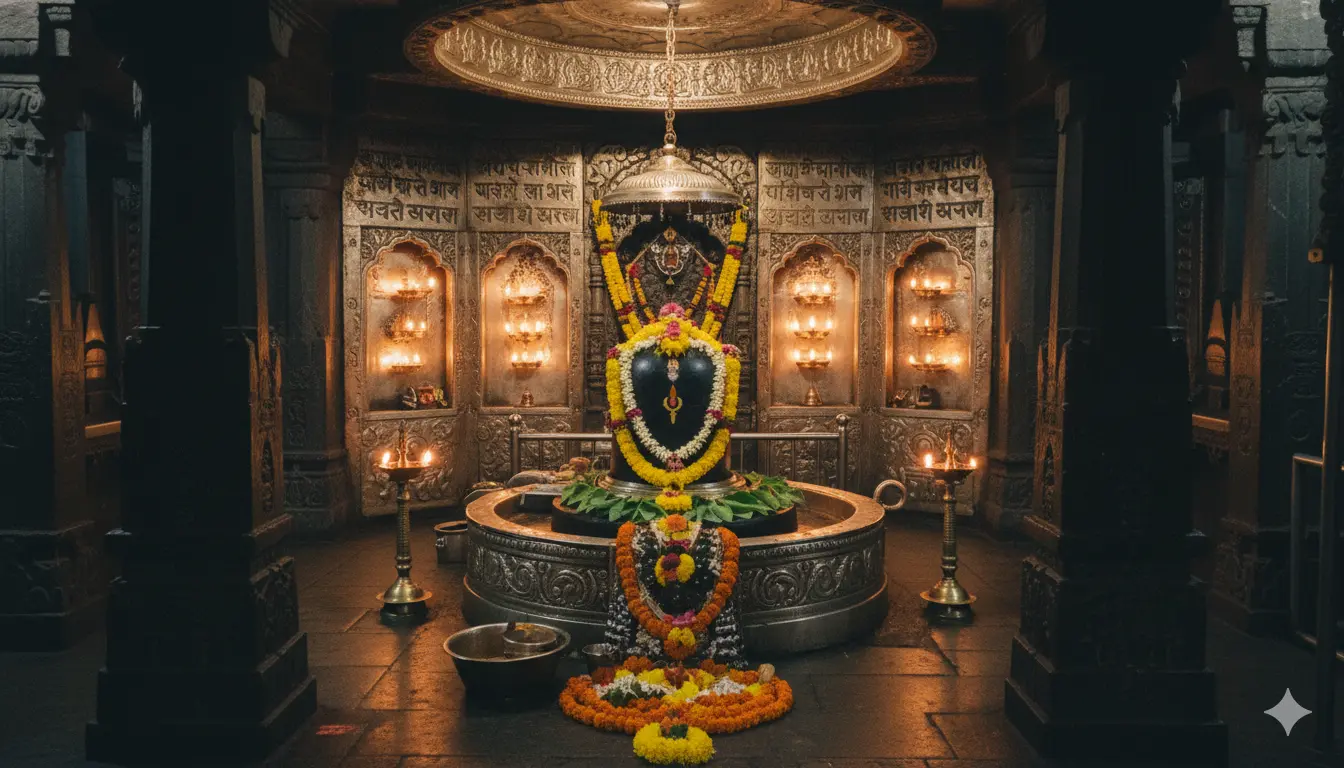
In Ujjain, in the innermost sanctum of Mahakaleshwar Temple, the most sacred Shivalinga in the world faces precisely south.
Directly, deliberately, defiantly south.
And the reason — when you understand it — reveals the true identity of Lord Mahakal in a way that nothing else does.
The Rule That Mahakal Breaks
In Hindu cosmology and Vastu tradition, the eight directions each carry a divine association:
- East: Indra (King of Gods)
- West: Varuna (God of Water/Order)
- North: Kubera (God of Wealth)
- South: Yama (God of Death)
- Northeast: Ishana (Auspicious)
- Northwest: Vayu (Wind)
- Southeast: Agni (Fire)
- Southwest: Nirriti (Chaos/Destruction)
South is Yama’s domain. Death’s door. The direction that inauspiciousness enters from. This is why in traditional Indian homes, you are advised not to sleep with your head pointing south — you are pointing yourself toward death’s domain.
For a temple — a place of divine presence, of life energy, of blessing — to face south is almost unthinkable. Temple architects throughout Indian history have gone to great lengths to ensure east-facing or north-facing entrances and idols.
But Mahakaleshwar faces south. Not by accident. Not as a mistake or limitation of geography. It was built this way intentionally, and the reason is encoded in the very name of the deity.
Mahakal: The One Who Has Already Conquered Death
“Mahakal” does not merely mean “Great God.” It means the Great Time — but more specifically, it means the one who has conquered Time and Death.
In Sanskrit, “Kaal” has a dual meaning: it means both “Time” and “Death.” They are the same word because they are, philosophically, the same force. Time is what kills everything. Death is time made final.
Mahakal — Maha Kaal — is the deity who stands above and beyond both. He is not subject to time. He is not subject to death. He is the master of the force that destroys everything else — a truth explored in the 2,000-year rule that even kings obeyed.
Now consider: if you are the conqueror of death, what do you do? You face it. You look directly at it. You do not turn away.
When the Mahakaleshwar Shivalinga faces south — when it faces directly into the domain of Yama, the God of Death — it is making a theological statement that is as clear as it is awe-inspiring:
I am not afraid of you. I am your master.
The Only Dakshina-Murti Jyotirlinga
“Dakshina” means south in Sanskrit. “Dakshina-Murti” means south-facing form. Lord Shiva does have a specific south-facing form — Dakshinamurthy — who is the teacher, the guru, the one who imparts wisdom while facing south. Dakshinamurthy faces his students who face north to receive his teachings.
Mahakaleshwar as a Jyotirlinga takes this to a cosmic level. The Swayambhu (self-manifested) linga facing south is not merely a guru posture — it is the supreme deity staring down death itself, permanently, as an eternal statement of his nature.
In all 12 Jyotirlingas, this occurs only once. Every other Jyotirlinga maintains conventional directional orientation. Mahakaleshwar alone faces south.
This uniqueness is one of the reasons why, among the 12, Mahakaleshwar is given supreme status in many scriptural hierarchies. He is the one who does what no other deity does. He confronts what all others avoid.
The Underground Garbhagriha: Another Break From Convention
The south-facing orientation is not the only architectural anomaly at Mahakaleshwar. The main Garbhagriha — the inner sanctum housing the Shivalinga — is located underground. You descend steps to reach it.
Most major Hindu temples have their Garbhagriha at ground level or elevated. Descending underground to reach the deity is a specific reference to the Swayambhu nature of the linga — it emerged from the earth, from below the surface, from the depths.
Underground. Facing south. The God of Time dwelling in the direction and the depth of death.
These are not coincidences of architecture. They are a complete cosmological statement built in stone over two thousand years ago.
What This Means for Devotees
When you stand in the Garbhagriha at Mahakaleshwar — underground, facing the south-facing linga, at 4 AM during the Bhasma Aarti with the scent of cremation ash in the air — you are not in a typical temple.
You are standing at the intersection of life and death, facing the deity who masters both.
The Bhasma — the ash — on the linga is not a coincidental ritual element. Ash is what everything becomes. It is death made tangible. And it is placed on Mahakal every single morning as an act of worship.
Ash on a south-facing underground god. Life worshipping death.
That is Ujjain. That is Mahakal.
Frequently Asked Questions
Why does Mahakaleshwar face south while other temples face east?
Mahakaleshwar faces south deliberately — south is the direction of Yama (death), and as Mahakal (the conqueror of Time and Death), Shiva faces the direction of death to signify his mastery over it. This is unique among all 12 Jyotirlingas.
Is it bad for a temple to face south in Hindu tradition?
Yes, in general Vastu Shastra and temple architecture guidelines, south-facing is avoided because south is associated with Yama (death). Mahakaleshwar is a deliberate exception, reflecting the deity’s unique nature as the lord who transcends death.
What does Dakshinamurthy mean?
Dakshinamurthy literally means “south-facing form” and is a specific manifestation of Shiva as the cosmic teacher and guru. The south-facing posture in this form symbolises wisdom, knowledge, and transcendence of death.
Is the Garbhagriha at Mahakaleshwar actually underground?
Yes. Unlike most major temples, the main sanctum (Garbhagriha) at Mahakaleshwar is located below ground level — you descend a flight of stairs to reach it. This reflects the Swayambhu (self-manifested from the earth) nature of the linga.

AGARWALPRODUCT Anti Tarnish Stainless Steel Midnight Charism...
₹199.00 (as of April 2, 2026 07:06 GMT +00:00 - More infoProduct prices and availability are accurate as of the date/time indicated and are subject to change. Any price and availability information displayed on [relevant Amazon Site(s), as applicable] at the time of purchase will apply to the purchase of this product.)
Arihant Gems & Jewels 5 Faced Nepali Rudraksha with 925 Silv...
₹1,199.00 (as of April 2, 2026 07:06 GMT +00:00 - More infoProduct prices and availability are accurate as of the date/time indicated and are subject to change. Any price and availability information displayed on [relevant Amazon Site(s), as applicable] at the time of purchase will apply to the purchase of this product.)
Arihant Gems & Jewels® 8 Mukhi Nepali Rudraksha Pendent | Na...
₹2,847.00 (as of April 2, 2026 07:06 GMT +00:00 - More infoProduct prices and availability are accurate as of the date/time indicated and are subject to change. Any price and availability information displayed on [relevant Amazon Site(s), as applicable] at the time of purchase will apply to the purchase of this product.)