
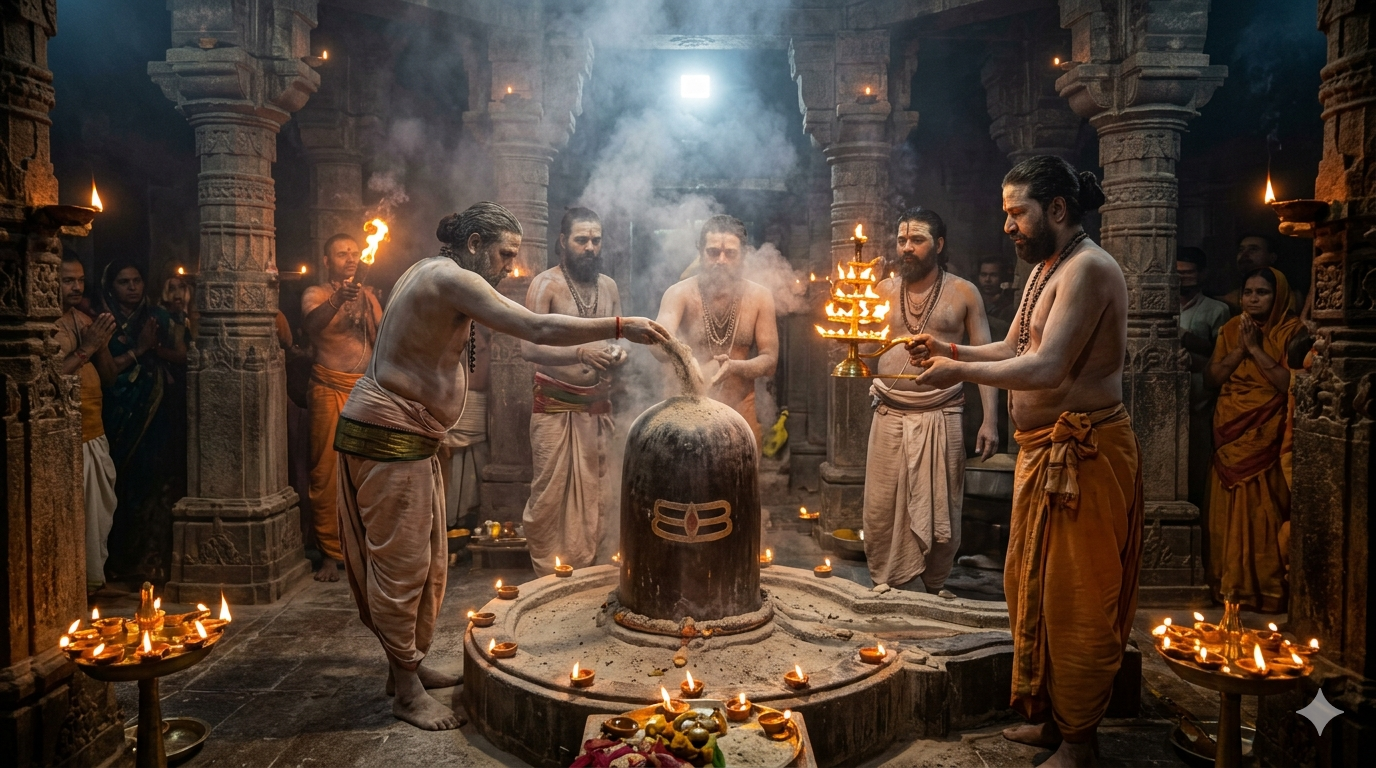
Every year, millions of people visit Mahakaleshwar Temple in Ujjain. They attend the Bhasma Aarti. They take darshan of the Jyotirlinga. They walk the Mahakal Corridor.
And almost none of them know that above their heads, on the third floor of the same temple complex, there is a shrine that has been sealed shut since the last time they visited.
It will be sealed shut again tomorrow. And the day after. And every day for the next 364 days.
This temple — the Nagchandreshwar Mandir — opens for exactly one night per year. Just one. For 24 hours, on the festival of Nag Panchami, the doors open and devotees may enter. Then they close again for another full year.
In all of India, there is no other major temple with this restriction. Not one.
What Is the Nagchandreshwar Temple?
The Nagchandreshwar Temple is located on the topmost floor of the Mahakaleshwar Temple complex — the third tier of the tower that rises above the main Garbhagriha where the Jyotirlinga is housed.
The deity worshipped here is Nagchandreshwar — Lord Shiva in the form of the Serpent-Moon God. The idol is remarkable and unique: it shows Shiva and Parvati seated on a throne made of the ten-headed serpent Ananta (the cosmic snake), with the snake’s hood spread protectively over the divine couple. Garuda, the eagle vehicle of Lord Vishnu, is also depicted — an unusual combination that carries deep symbolic significance about the harmony of cosmic forces.
The idol is considered extraordinarily powerful. According to temple tradition and local belief, the concentrated divine energy of the Nagchandreshwar shrine is so intense that unrestricted public access would be spiritually overwhelming. Hence the restriction.
Why Only One Day?
The explanation given by temple priests and backed by scriptural tradition is this:
Nag Panchami — the fifth day of the bright fortnight in the month of Shravan (July/August) — is the day sacred to serpents (nagas). On this day, serpents are worshipped across India. Snakes are brought milk offerings. Temples with serpent deities see massive crowds.
For Nagchandreshwar specifically, Nag Panchami is the one day when the deity is considered most receptive to the prayers of devotees — when the cosmic alignment of the day matches the nature of the deity. On this day alone, the shrine opens.
The timing of the annual opening is treated as a major event. Temple priests perform special rituals. Devotees line up from the previous night. By morning, queues stretch out of the temple complex and down the street. In peak years, hundreds of thousands of people attempt to take darshan within the 24-hour window.
What Happens on Nag Panchami at Mahakaleshwar
The 24-hour opening of Nagchandreshwar follows a strict schedule. The doors open at midnight at the start of Nag Panchami. Special pujas are performed throughout the night by senior temple priests. Devotees begin entering from early morning. The queue during peak hours can mean a wait of 4–6 hours. The doors close precisely 24 hours after opening.
Inside the small chamber, the idol is adorned with fresh flowers, sandalwood paste, and milk offerings. The atmosphere is described by those who have experienced it as unlike any other darshan in the temple — deeply concentrated, very quiet, and profoundly affecting.
The Three Floors of Mahakaleshwar: A Temple Within a Temple
Most visitors to Mahakaleshwar are unaware that the temple complex contains three distinct levels of worship, each with its own deity.
Ground Level (Underground Garbhagriha): The main Mahakaleshwar Jyotirlinga — the self-manifested Shivalinga that faces south. This is what most visitors come to see.
First Floor: Omkareshwar — a shrine to the Omkareshwar Jyotirlinga form of Shiva, one of the 12 Jyotirlingas.
Third Floor (Top): Nagchandreshwar — sealed 364 days a year.
This vertical arrangement — from the deepest underground to the highest point of the tower — is a deliberate architectural and spiritual design. The further up you go, the more restricted and concentrated the divine energy. The underground linga is accessible daily to thousands. The top-floor shrine admits the world for one day only.
How to Plan Your Visit for Nag Panchami
If you want to experience the Nagchandreshwar darshan: Nag Panchami falls in July or August each year (specific date varies by Hindu calendar). Arrive early — the queue builds rapidly after opening. Book accommodation in Ujjain well in advance as hotels fill up weeks before Nag Panchami. Plan to combine with Bhasma Aarti (4 AM) and join the Nagchandreshwar queue on the same morning for a complete Mahakaleshwar experience.
Frequently Asked Questions
When does the Nagchandreshwar Temple open?
The Nagchandreshwar Temple opens once a year on Nag Panchami — the fifth day of the bright fortnight in the Hindu month of Shravan (typically July or August). It remains open for 24 hours and then closes for the rest of the year.
Where exactly is the Nagchandreshwar Temple?
It is on the third (topmost) floor of the Mahakaleshwar Temple complex in Ujjain. Most visitors never go above the ground floor level where the main Jyotirlinga is located.
Why is the temple kept sealed for 364 days?
According to temple tradition, the concentrated divine energy of the Nagchandreshwar shrine is considered too intense for unrestricted daily access. The single annual opening on Nag Panchami aligns with the cosmic significance of the day for serpent deities.

AGARWALPRODUCT Anti Tarnish Stainless Steel Midnight Charism...
₹199.00 (as of April 2, 2026 07:06 GMT +00:00 - More infoProduct prices and availability are accurate as of the date/time indicated and are subject to change. Any price and availability information displayed on [relevant Amazon Site(s), as applicable] at the time of purchase will apply to the purchase of this product.)
Arihant Gems & Jewels 5 Faced Nepali Rudraksha with 925 Silv...
₹1,199.00 (as of April 2, 2026 07:06 GMT +00:00 - More infoProduct prices and availability are accurate as of the date/time indicated and are subject to change. Any price and availability information displayed on [relevant Amazon Site(s), as applicable] at the time of purchase will apply to the purchase of this product.)
Arihant Gems & Jewels® 8 Mukhi Nepali Rudraksha Pendent | Na...
₹2,847.00 (as of April 2, 2026 07:06 GMT +00:00 - More infoProduct prices and availability are accurate as of the date/time indicated and are subject to change. Any price and availability information displayed on [relevant Amazon Site(s), as applicable] at the time of purchase will apply to the purchase of this product.)