
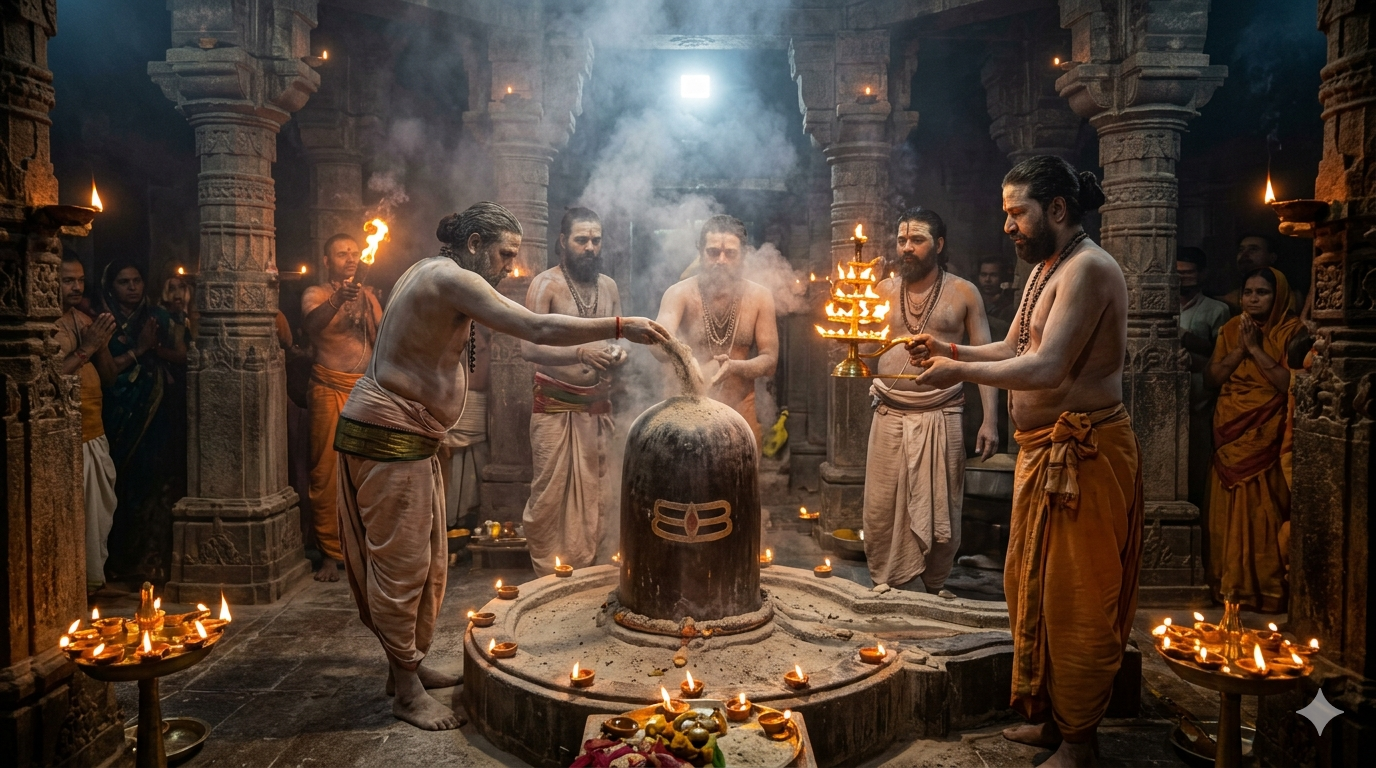
Every morning before dawn, a group of priests at Mahakaleshwar Temple in Ujjain performs a ritual that has continued uninterrupted for two thousand years.
They take fresh ash.
And they smear it on a god.
This is the Bhasma Aarti — the most sacred, most watched, most sought-after ritual in all of Shaivism. Hundreds of thousands of people book passes months in advance for the privilege of witnessing it. Politicians, saints, celebrities, ordinary devotees — all want to be in that chamber at 4 AM.
But most of them don’t know exactly where that ash comes from.
And when they find out, it changes everything about what they just witnessed.
What Is Bhasma?
“Bhasma” in Sanskrit simply means “ash.” But in the context of Shaivite ritual, bhasma has a very specific meaning and a very specific origin.
In the classical Shaivite tradition — the tradition that Mahakaleshwar Temple follows — the bhasma used in worship was not ordinary ash from wood fires. It was not incense ash. It was not cow-dung ash.
It was masan bhasma — ash from the cremation grounds. Specifically, ash from the first cremation of the day, collected from the funeral pyres where human bodies had been burned.
This is documented in ancient temple texts, in the Shaiva Agamas (the ritual manuals that govern temple worship), and in historical accounts of Mahakaleshwar’s rituals going back many centuries.
The Lord of Death is worshipped with the ash of the dead.
Why Cremation Ash? The Theological Logic
This is not sensationalism. It is not a dark curiosity. It is one of the most profound theological statements in all of Hindu ritual, and understanding it transforms the Bhasma Aarti from a fascinating spectacle into something that reaches inside you.
Lord Shiva — as Mahakal — is the deity who governs the end of things. He is Mritunjaya: the conqueror of death. He is depicted smeared in ash in virtually every iconographic representation precisely because the ash represents the ultimate truth about physical existence:
Everything burns. Everything becomes ash. Nothing that is made of matter escapes this.
By smearing the Shivalinga with cremation ash, the priests are not performing a morbid act. They are performing an act of cosmic truth-telling. They are saying: this deity understands what everything returns to. This deity is made of what everything becomes. He does not fear it. He wears it.
Lord Shiva’s traditional depiction shows him as the Maha-Yogi seated in cremation grounds (shmashana), smeared in ash, surrounded by the smoke of funeral pyres. Mahakaleshwar’s Bhasma Aarti is a daily re-enactment of this reality — not in some metaphorical or sanitised way, but literally, with actual cremation ash, every single morning, as it has been performed for two millennia.
The 2,000-Year Unbroken Chain
What makes this even more extraordinary is the continuity.
The Bhasma Aarti at Mahakaleshwar has not been interrupted. Not during Mughal rule. Not during British colonisation. Not during partition, independence, wars, or any other political upheaval. The priests have performed this ritual at 4 AM every single morning for approximately 2,000 years.
The same ritual. The same timing. The same ash.
Think about what that means. In 2,000 years, how many human beings have been cremated near Ujjain? How many funerals have provided the first ash of the morning for this ritual? How many families, grieving their dead, have unknowingly contributed to the most sacred ceremony in Shaivism?
This is part of the point. Ujjain has always been a city of both birth and death. The Shipra River receives the ashes of the dead from across India. The cremation grounds near Ujjain are ancient. And from those grounds, every morning, comes the bhasma that adorns Mahakal.
Death feeding the worship of the God of Death. It is a closed loop, and it has been running for two thousand years.
The Ritual Itself: What Actually Happens During Bhasma Aarti
For those who have never attended, or who have attended without knowing the significance of the ash, here is what happens:
3:30 AM: Devotees with valid passes begin entering the temple. Security checks are thorough. No phones or electronics are permitted inside the aarti hall.
4:00 AM: The senior priests enter the Garbhagriha. The chamber, underground, is lit by oil lamps. The air fills with the scent of flowers, incense, and the particular smell of bhasma.
The Ritual: Priests perform Abhishek (ritual bathing) of the Shivalinga with various sacred substances. Then comes the bhasma — applied directly to the Shivalinga by hand, carefully, ritually, with specific Sanskrit mantras recited throughout.
The Moment: When the fresh ash is applied, the Shivalinga changes appearance. The dark stone becomes grey. The Lord of Time is dressed in the substance of mortality itself.
The Atmosphere: Many devotees describe this moment as the single most powerful spiritual experience of their lives. Not because of anything dramatic or theatrical — but because of the combination of elements: the hour, the darkness, the underground chamber, the ash, the chanting, and the understanding of what it all means.
Duration: The full aarti lasts 1.5 to 2 hours, ending with flower offerings, bilva leaves, and a final darshan.
The Bhasma Prasad: What Devotees Receive
After the Bhasma Aarti, small quantities of the bhasma are distributed as prasad (blessed offering) to devotees. Receiving this ash — touching it to your forehead — is considered among the most powerful blessings available in the Hindu tradition.
The three horizontal lines of ash drawn on the forehead (called Tripundra) are the mark of Shiva devotees. In this context, when you draw those lines with bhasma received from the Bhasma Aarti at Mahakaleshwar, you are marking yourself with ash that carried the energy of that underground chamber, that pre-dawn ritual, and those two thousand years of unbroken continuity.
What Has Changed (And What Hasn’t)
In more recent centuries, as cremation grounds moved further from the temple area, the sourcing of bhasma has evolved somewhat. Temple priests and scholars note that the bhasma used today may include additional sacred ash types (from sacred fires, cow dung, and other ritual sources mixed with cremation ash), with the specific composition varying by tradition and priestly lineage.
What has not changed is the fundamental nature of the ritual: Mahakal is worshipped with ash. The ash represents death. The worship of the God of Time with the symbol of mortality has continued every single morning, without exception, for two thousand years.
Frequently Asked Questions
Is the bhasma used in Bhasma Aarti actually from cremation grounds?
According to classical Shaivite tradition and ancient temple texts, the bhasma used for worshipping Mahakal was masan bhasma — ash from cremation grounds. This is documented in the Shaiva Agamas. In current practice, the exact composition varies, but the ceremonial use of bhasma as a representation of mortality is unchanged.
Why does Shiva wear ash in all his depictions?
Ash represents the ultimate truth of physical existence — that everything material eventually burns and becomes ash. Shiva, as the deity of destruction and regeneration, wears ash to symbolise his mastery over this process and his existence beyond it.
Can women attend the Bhasma Aarti?
Yes. Women can fully attend and participate in the Bhasma Aarti with a valid pass and appropriate traditional dress. There is no gender restriction.
How far in advance should I book the Bhasma Aarti pass?
At least 30 days in advance for regular dates. For Mondays (Somwar), Mahashivratri, and festival periods, book as early as possible — 2–3 months is advisable.

AGARWALPRODUCT Anti Tarnish Stainless Steel Midnight Charism...
₹199.00 (as of April 2, 2026 07:06 GMT +00:00 - More infoProduct prices and availability are accurate as of the date/time indicated and are subject to change. Any price and availability information displayed on [relevant Amazon Site(s), as applicable] at the time of purchase will apply to the purchase of this product.)
Arihant Gems & Jewels 5 Faced Nepali Rudraksha with 925 Silv...
₹1,199.00 (as of April 2, 2026 07:06 GMT +00:00 - More infoProduct prices and availability are accurate as of the date/time indicated and are subject to change. Any price and availability information displayed on [relevant Amazon Site(s), as applicable] at the time of purchase will apply to the purchase of this product.)
Arihant Gems & Jewels® 8 Mukhi Nepali Rudraksha Pendent | Na...
₹2,847.00 (as of April 2, 2026 07:06 GMT +00:00 - More infoProduct prices and availability are accurate as of the date/time indicated and are subject to change. Any price and availability information displayed on [relevant Amazon Site(s), as applicable] at the time of purchase will apply to the purchase of this product.)