Phone:
(701)814-6992
Physical address:
6296 Donnelly Plaza
Ratkeville, Bahamas.

Phone:
(701)814-6992
Physical address:
6296 Donnelly Plaza
Ratkeville, Bahamas.

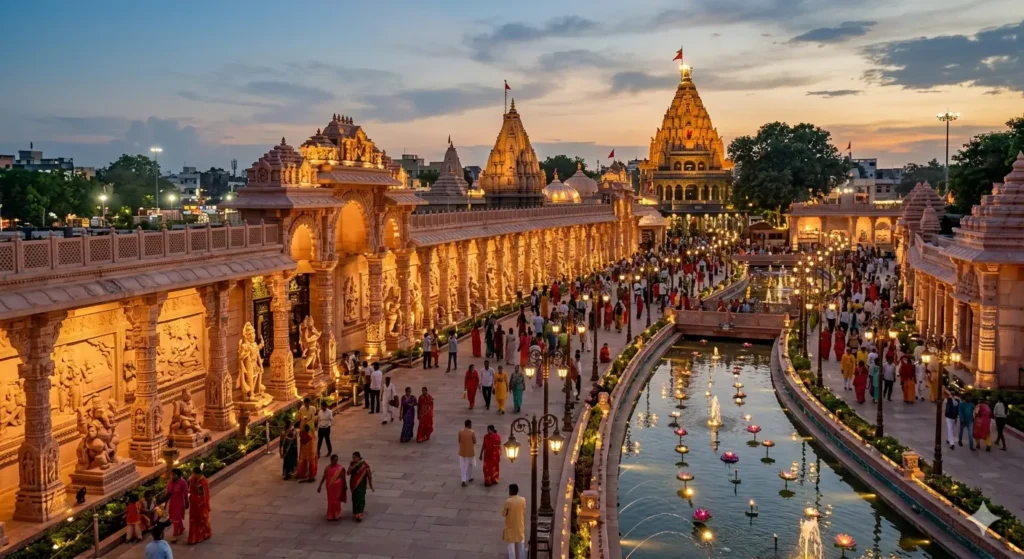
UJJAYINI
The Phoenix of Indian Civilization
A Definitive Guide to Architecture, History & Sacred Design
Ujjayini — known through the ages as Avanti, Vagdevi, and the City Eternal — is more than a place on a map. It is a living continuum, a cultural and spiritual axis around which Indian civilization has revolved for over three millennia. Archaeological and textual evidence places its founding as far back as 900 B.C., yet the city’s resonance feels older still, as though it emerged from the earth in the same primordial act that shaped the Vindhya ranges to its south.
Ancient Indian scholars described Ujjayini in terms that would today be called ecological and cosmological: a goddess who preserves living beings in their germinal form, capable of springing up again and again across different kalpas (eons) like a phoenix from the ashes. This is not mere mythology. The city has been burned, sacked, and erased, only to resurrect itself each time around its sacred core. That core — the Mahakaleshwar Temple, seat of one of the twelve jyotirlingas — has functioned as a spiritual anchor through conquest and reconstruction alike.
Ujjayini served as a vital crossroads for the dissemination of Buddhism and Jainism across the subcontinent. The Emperor Ashoka’s children are said to have departed from its gates to propagate the Dharma in Sri Lanka. But the city’s significance was never solely religious. In a remarkable convergence of science and sacred geography, ancient Indian astronomers designated Ujjayini as the navel of the earth, using it as a Prime Meridian — a conceptual Greenwich — centuries before the global adoption of any standardized longitude.
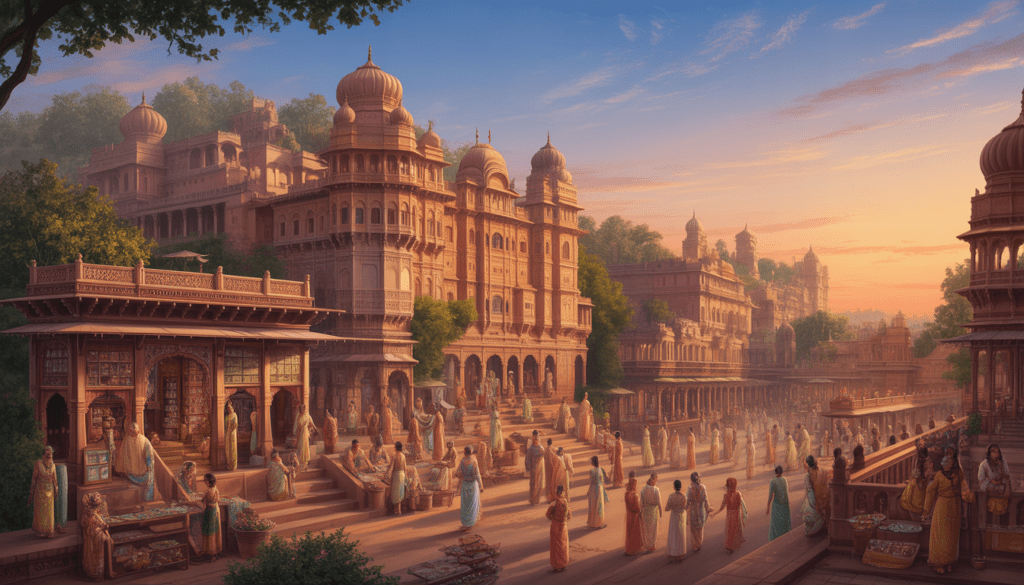
Between the 9th and 14th centuries A.D., the Paramara Dynasty transformed the Malwa plateau into one of the most culturally luminous regions of medieval India. Under their rule, Ujjayini and the neighboring capital of Dhar became sanctuaries for what Sanskrit poets called the Goddess of Learning — a court culture in which military prowess and literary refinement were considered inseparable virtues.
The Paramara renaissance began in earnest under Vakpati-Munja, a ruler remarkable for combining military campaigns across the Deccan with an extraordinary patronage of Sanskrit literature. His court nurtured luminaries such as Padmagupta, author of the Navasahasanka-carita, and Dhananjaya, whose dramatic treatise Dasarupaka remained a reference work for centuries. Munja himself composed verse, and he is credited with the excavation of the Munjasagara tank at Dhar — a reservoir that served both practical and ceremonial functions. He embodied the ideal of the raj-rishi, the king-sage.

King Bhoja (r. c. 1010–1055 A.D.) stands alone in the annals of Indian kingship as perhaps the most versatile monarch the subcontinent has ever produced. He was simultaneously a military leader, urban planner, engineer, grammarian, astronomer, physician, and poet. His written legacy spans at least 84 treatises — a figure that, even allowing for later attributions, suggests a mind of staggering range.
His architectural masterwork, the Samarangana-sutradhara, is an encyclopedic text on town planning, construction principles, and the design of mechanical devices. It codified the Bhumija Nagara style that his royal workshops were perfecting in stone, establishing measurement systems, geometric proportions, and structural hierarchies that guided builders for generations. His engineering ambition was equally vast in the physical world: the Bhojpur Lake, created by damming the Betwa river, once extended over 250 square miles, making it one of the largest artificial lakes in pre-modern history.
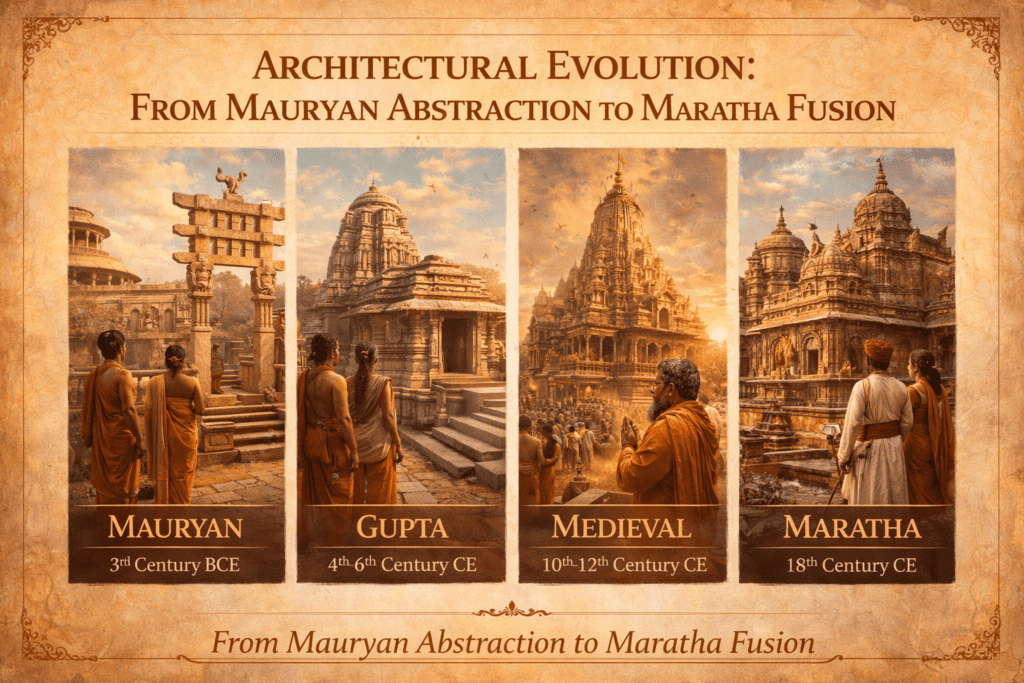
The built environment of Ujjayini and Malwa traces an arc from the refined austerity of the Mauryan period, through the ornate exuberance of Rajput temple-building, to the syncretic boldness of Maratha reconstruction. Each phase left its sediment in the landscape; nowhere is this accumulation more visible than in the Mahakaleshwar complex.
The Bhumija architectural style, a distinguished sub-tradition of the broader Nagara canon, reached its zenith under Paramara patronage. Its most immediately recognizable feature is the shikhara — the temple tower — which departs from both the soaring verticality of Dravidian vimanas and the clustered profiles of the Khajuraho school. Instead, the Bhumija shikhara achieves its effect through concentric rings of stone that diminish progressively upward, creating a curvilinear silhouette that conveys what its creators understood as dynamic upward movement rooted in sacred geometry.
The outer surfaces of these towers are subdivided by decorated horizontal and vertical bands into precise grids, each cell filled with a miniature shikhara (uruvshringa). The effect is one of infinite regression — a tower made of towers. The Nilakanthesvara temple provides a precise example: its tower carries exactly thirty-five miniature spires arranged in five equal rows. The structural technology supporting this visual complexity relied on traditional dry masonry — no mortar, just precision-cut sandstone blocks whose weight and fitted joints ensured stability, sometimes reinforced with iron clamps and dowels.
Compared to the Maru-Gurjara style of Rajasthan, with its exuberant interlocking carvings, or the Khajuraho school’s layered re-entrant plans, the Bhumija idiom is defined by measured repetition and geometric discipline. Where South Indian temples used imposing Gopurams (gateway towers) to announce a sacred precinct, the Bhumija tradition placed its emphasis on the sanctum tower itself; the Gopurams visible today at Mahakaleshwar are Maratha-period additions.
Among Bhoja’s architectural projects, the Bhojesvara Temple at Bhojpur stands as a monument of deliberate simplicity. Where contemporaries favored multi-shrine panchayatana plans with complex re-entrant angles, Bhoja chose a pure square for this temple — 66 feet on the exterior — as though asserting that sacred power required no elaboration. Four interior pillars, each 40 feet high, frame a sanctum containing one of the largest lingams in India: seven and a half feet high, seventeen feet eight inches in circumference, set on a platform measuring twenty-one and a half feet square. The lingam was never finished, and the temple itself was never roofed — yet it communicates more through its incompleteness than many finished structures do through their perfection.
The Mahakaleshwar Temple occupies a category entirely its own. As one of the twelve jyotirlingas — sites where Shiva is said to manifest as a pillar of light — it holds a rank in Hindu cosmology that makes it not merely a place of worship but a cosmic coordinate. Its singular distinction within the jyotirlinga canon is its orientation: Mahakaleshwar is Dakshinamurti, facing south, a direction associated with Yama, the lord of time and death. The deity here is Mahakala — the Lord of Time — and the temple’s location at the traditional intersection of the Prime Meridian and the Tropic of Cancer gives this title an almost literal astronomical weight.
The temple’s structural history is a saga compressed into stone and memory. In the 13th century, the Turk ruler Shams-ud-din Iltutmish sacked the complex, dismantling structures that had accumulated centuries of devotional and architectural investment. The destruction was not merely material; it was intended as an erasure of the sacred geography itself. Yet the site endured in popular memory and ritual practice, and by the 18th century it was rebuilt.
The current five-storeyed structure was raised in 1734 under the patronage of the Maratha general Ranoji Shinde. The Maratha builders did not attempt a pure archaeological reconstruction of earlier forms; instead they produced a confident synthesis, weaving together Bhumija spire elements, Chalukya decorative vocabulary, and the robust simplicity characteristic of Maratha military architecture. The result is a building that carries multiple centuries within its masonry — a palimpsest in stone.
The most recent chapter in Mahakaleshwar’s architectural biography is the Shri Mahakal Lok corridor, inaugurated to create an expanded spiritual and civic precinct around the temple. Conceived at four times the scale of the Kashi Vishwanath corridor in Varanasi, it represents one of independent India’s most ambitious acts of sacred urban design — an attempt to simultaneously serve millions of pilgrims annually, restore the visual integrity of the temple’s environs, and stimulate the broader economic ecosystem of Ujjain.
Contemporary stewardship of the Mahakaleshwar complex has confronted a problem that sits at the intersection of geology, chemistry, and devotion. Scientific investigations presented to the Supreme Court of India revealed that the Mahakaleshwar lingam — composed of orthoquartzite — has been undergoing measurable erosion. The cause is not time but the very practices of veneration: alkaline ritual water, impure ceremonial offerings, and fluctuating temperatures are accelerating chemical weathering of a stone that has survived centuries of harder challenges.
The preservation protocols now mandated reflect a sophisticated reading of both materials science and liturgical practice. RO plants have been installed to maintain the water used for abhisheka at a neutral pH of 7, preventing alkaline attack on the stone surface. Offerings are restricted to symbolic quantities to eliminate bacterial growth and the acidic byproducts of organic decomposition. The ambient temperature inside the garbhagriha (sanctum) is maintained between 17 and 20 degrees Celsius to minimize the rate of thermal expansion and chemical reaction. These are not compromises of ritual — they are a recognition that preservation is itself a form of devotion.
The architectural traditions of Ujjayini and Malwa exist within a broader constellation of Indian sacred design achievements. A comparative survey illuminates both the shared principles and the distinctive local genius that make Paramara-era buildings so remarkable.
Constructed between the 11th and 13th centuries, the Dilwara temples are celebrated above all for their white marble carving — an achievement so fine that the pendant ceiling domes are said to surpass even European Gothic stonework in their delicacy. Where the Bhumija style achieves grandeur through geometric repetition, Dilwara achieves it through the virtuosic elaboration of individual forms. The two traditions represent opposite ends of a spectrum within the shared Nagara inheritance.
The Akshardham complex, completed in 2005, represents a deliberate modern revival of the Shilpa Shastras, the ancient Sanskrit manuals of temple craft. Its central monument rests on a plinth carried by 148 life-sized stone elephants, a plinth weighing 3,000 tons. The project demonstrates that the design intelligence embedded in texts like the Samarangana-sutradhara remains generative — capable of producing new architecture rather than merely inspiring its study.
The 13th-century Konark Sun Temple was conceived as a monumental stone chariot for the sun god Surya — complete with 24 carved wheels representing the months of the year and seven horses pulling the solar vehicle across the sky. It exemplifies the most ambitious aspiration of Indian temple design: to make the cosmos legible in stone, so that walking around a temple is equivalent to moving through time itself.
What Ujjayini offers the contemporary designer — architect, urban planner, conservationist, or digital storyteller — is not a museum of frozen forms but a live curriculum in endurance. Its most important lesson is that the sacred and the scientific are not in tension: the same civilization that built the Mahakaleshwar Temple also made it the zero meridian of a coordinate system. The same king who authored devotional verse also calculated structural loads and hydraulic gradients.
The Bhumija shikhara, with its recursive miniature spires, anticipates ideas that computer graphics would formalize as fractal geometry. The dry masonry of Paramara builders — achieving structural integrity through precision rather than adhesion — resonates with contemporary principles of reversible and sustainable construction. The Supreme Court-mandated preservation chemistry at Mahakaleshwar is, in its own way, a continuation of the same intellectual tradition that produced the Samarangana-sutradhara: the conviction that care for the sacred requires the most rigorous deployment of available knowledge.
Ujjayini has been a phoenix before. Each time it rises, it incorporates what destroyed it and carries the residue of every previous incarnation. That is not merely a historical observation. For any design vision that aspires to endure, it is perhaps the most practical instruction available