Phone:
(701)814-6992
Physical address:
6296 Donnelly Plaza
Ratkeville, Bahamas.

Phone:
(701)814-6992
Physical address:
6296 Donnelly Plaza
Ratkeville, Bahamas.

| Temple Name | Shri Mahakaleshwar Jyotirlinga, Ujjain |
| Location | Jaisinghpura, Ujjain, Madhya Pradesh — 456001 |
| Type | One of 12 Jyotirlingas | Swayambhu | Dakshinamukhi (only south-facing) |
| Temple Opens | 4:00 AM daily |
| Temple Closes | 11:00 PM daily |
| Bhasma Aarti | 4:00 AM – 6:00 AM (advance booking mandatory) |
| Nearest Airport | Devi Ahilyabai Holkar Airport, Indore — 56 km |
| Nearest Railway | Ujjain Junction — 2 km from temple |
| Entry Fee | General darshan free | Sheeghra Darshan ₹250 | Garbh Grah ₹750 |
| Official Booking | shrimahakaleshwar.com |
| Architecture | Maratha + Bhumija + Chalukya styles |
| Floors | 5 levels (one underground) |
There is a moment, right around 3:00 AM, when the lanes around Mahakaleshwar Temple begin to move. Not with traffic — with people. Old men in white dhotis, young couples from faraway cities, families who have traveled overnight from Maharashtra or Gujarat, sadhus who seem to materialize from nowhere. The air carries sandalwood and damp stone and the faint warmth of tea being brewed at a roadside stall. And in the distance, rising above all of it — the five-tiered shikhara of Mahakaleshwar, lit gold against a still-dark sky.
This is Ujjain at 3:00 AM. And this is why millions of people come here.
Mahakaleshwar Temple is not just one of the twelve Jyotirlingas. It is the only Jyotirlinga that faces south — the direction of death in Hindu cosmology — which means that Lord Shiva, as Mahakal, Lord of Time and Death, directly confronts mortality. Devotees believe that darshan here doesn’t just bless you. It grants liberation. It dissolves the fear of death itself.
This guide covers everything you need for a complete, smooth darshan at Mahakaleshwar in 2026 — from the temple’s five-level architecture and rare facts most guides get wrong, to practical booking information, darshan types and prices, the Mahakal Lok corridor, the Mahakal Sawari procession, and how to plan your visit from Indore or beyond. For detailed Bhasma Aarti timings and the full daily aarti schedule, see our complete Bhasma Aarti timing guide.
Every spiritual tradition in India holds Mahakaleshwar apart from the other eleven Jyotirlingas — and the reasons are more specific and more fascinating than most articles explain. Here are the five characteristics that are unique to this temple alone.
All eleven other Jyotirlingas face east — the direction of sunrise, of beginnings, of life. Mahakaleshwar faces south. In Hindu cosmological tradition, south is the direction of Yama, the god of death. South is the direction from which no one returns.
The theological implication is profound. By facing south, Lord Shiva as Mahakal literally confronts death — he looks into its face. The name itself encodes this: Maha means great, Kaal means time and death. Mahakal is the one who transcends time, who stands over death rather than being governed by it. Devotees who seek darshan here are not merely praying for blessings. They are standing before the one deity who has defeated the concept of mortality itself. This is why the Varaha Purana states that a single darshan of Mahakaleshwar grants liberation — moksha — that would otherwise take thousands of lifetimes to earn.
Most temple lingams are ritually installed and empowered through Vedic consecration ceremonies called Prana Pratishtha. The Mahakaleshwar Jyotirlinga is Swayambhu — self-born. It appeared from the earth of its own accord and derives its power from within itself, not from human ritual.
The theological distinction matters enormously. A priest-installed lingam depends on the purity of the installation and the continuity of ritual maintenance for its power. A Swayambhu lingam is understood to be eternally self-powered. This is also why, according to tradition, prasad offered at Mahakaleshwar can be re-offered at other shrines — a privilege unique to this temple among all twelve Jyotirlingas, since the sanctity flows from the deity itself rather than from the ritual.
Mahakaleshwar is not only a Jyotirlinga. It is simultaneously one of the 18 Maha Shakti Peethas — the sacred sites where parts of Goddess Sati’s body are said to have fallen. Within the Mahakaleshwar complex, a shrine to Goddess Avantika — the patron goddess of Ujjain — marks the spot where her upper lip is said to have fallen. This dual sanctity as both Jyotirlinga and Shakti Peetha makes Mahakaleshwar one of very few places in India that carries both classifications simultaneously.
The poet Kalidasa — author of Meghdoot, Abhigyanashakuntalam, and Raghuvamsam — lived in Ujjain during the reign of Chandragupta II in the 4th–5th century CE. His works contain some of the earliest literary descriptions of Mahakaleshwar. Meghdoot describes the temple as Niketana — a cosmic dwelling. The Mahakal Lok Corridor’s murals explicitly reference Meghdoot as their source material.
The fact that this temple appears in literature from 1,600 years ago as an already-ancient and revered site — not as a newly-built structure — speaks to a continuous sacred tradition that archaeologists estimate may extend to the 6th century BC, when punch-marked coins from Ujjain bearing Shiva’s symbols were in circulation.
According to the Varaha Purana, Ujjain sits at the geographical center of the earth — the Nabhi, or navel. This is more than myth. Ujjain was historically positioned on what ancient Indian astronomers calculated as the zero meridian — their equivalent of Greenwich. The ancient observatory Jantar Mantar in Ujjain was built from this assumption. Lord Shiva, residing at the earth’s center, was therefore understood as the axis around which all time revolves — which reinforces the Mahakal symbolism at every level.
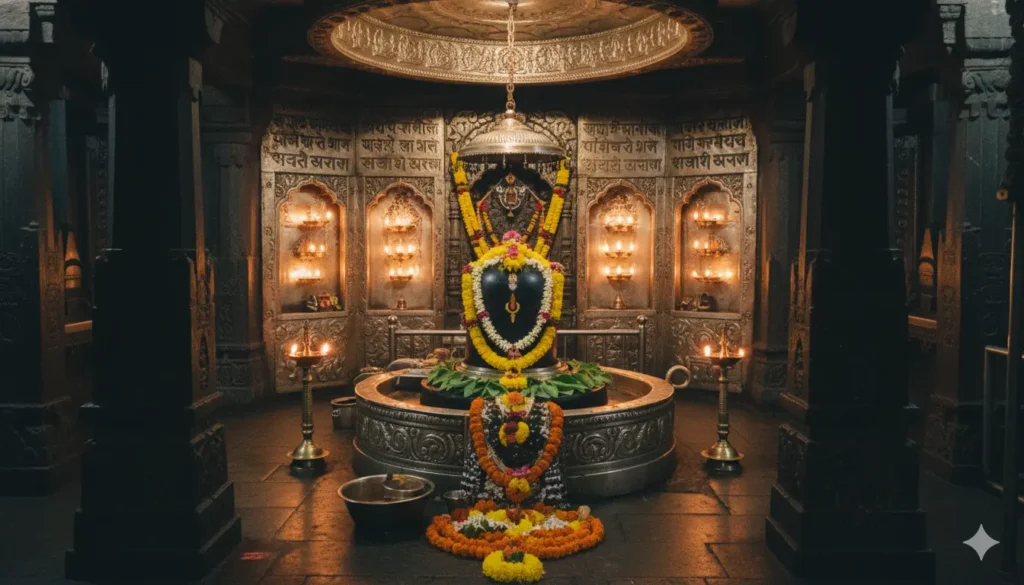
[ Upload Image: mahakaleshwar-jyotirlinga-sanctum.jpg — Alt text: mahakaleshwar jyotirlinga sanctum — swayambhu dakshinamukhi shivlinga inside garbhagriha ujjain ]
One of the most consistently misreported facts about Mahakaleshwar is its structure. Most articles say it has “three floors.” The temple actually has five distinct levels, one of which is underground. Understanding the layout helps you plan your darshan and know what you are actually looking at. For the full architectural and historical background, see our Mahakal Temple History guide.
The main Shivlinga of Mahakaleshwar is housed below ground level — in a sunken sanctum that you descend into via stone steps. The underground position is intentional and deeply symbolic. It places the lingam literally within the earth, consistent with the Swayambhu narrative of the deity rising from the ground. The ceiling of the Garbhagriha is plated with silver. The walls are inscribed with sacred mantras. Brass lamps light the passage from the surface down to the sanctum.
Within the sanctum, the Shivlinga occupies the center. Surrounding it in the cardinal directions are the deities of Shiva’s family: Goddess Parvati to the north, Lord Ganesha to the west, Lord Kartikeya to the east. To the south — the direction Mahakal faces — stands the image of Nandi, Shiva’s bull vehicle, gazing eternally at the deity.
Above the underground sanctum, the ground level consists of the Sabha Mandap — the large assembly hall where devotees gather. This is where the queue for general darshan is managed. The Sabha Mandap is adorned with elaborate sculptural panels depicting scenes from Hindu mythology, including episodes from the Shiva Purana.
Directly above the Mahakaleshwar sanctum on the first floor is a shrine to Omkareshwar — another form of Shiva and also one of the twelve Jyotirlingas (located 140 km south of Ujjain). This superimposition of one Jyotirlinga shrine above another is unusual and sacred. Devotees who visit Mahakaleshwar often proceed upstairs after their main darshan to also receive darshan of Omkareshwar.
On the third storey — counted as the second floor above ground — is the Nagchandreshwar shrine, housing a rare idol of Lord Shiva and Goddess Parvati seated on Takshaka, the king of serpents, who spreads his ten hoods as a canopy above them. The idol is considered one of the most exquisite sculptures in the temple.
Here is the fact most guides mention but none explain: this shrine is open for darshan exactly one day per year — on Nag Panchami, which falls in Shravan month (July–August). On every other day of the year, the door is closed. The belief is that Takshaka himself guards the shrine during the remaining 364 days. If your visit coincides with Nag Panchami, you gain access to a darshan that is simply unavailable on any other day.
The towering shikhara that dominates the Ujjain skyline was rebuilt during the Maratha period in the 18th century under Ranoji Shinde’s Diwan, Ramchandra Baba Shenavi (Sukhtankar). The architectural style fuses three traditions: the Bhumija style from central India, the Chalukya style from the Deccan, and the Maratha style. Art historians note that prior to the Gupta period, the temple had a flat roof with no shikhara — this is referenced in Kalidasa’s description. The current spire is roughly 300 years old, built over a site of continuous worship spanning at least 2,500 years.
The temple follows two seasonal schedules — a winter calendar and a summer calendar. The Bhasma Aarti remains fixed at 4:00 AM year-round. For the complete seasonal timing breakdown with all variations, see our Mahakal Temple Timings guide.
| Ritual / Event | Time | Notes |
|---|---|---|
| Temple gates open (Bhasma Aarti) | 2:30 AM | Booked devotees only |
| Jal Abhishek (Garbhagriha access) | 3:15 AM – 4:00 AM | Jalabhishek pass holders only |
| Bhasma Aarti begins | 4:00 AM | Advance booking mandatory. 4 mandapam zones. |
| Bhasma Aarti concludes | ~6:00 AM | Duration approx. 2 hours |
| General Darshan opens | 6:00 AM | Free. No booking needed. |
| Bhog Aarti | 10:30 AM – 11:15 AM | Free. Open to all. |
| Sandhya Aarti (evening) | 7:30 PM – 8:30 PM | Free. No booking needed. |
| Shayan Aarti (night) | 10:30 PM – 11:00 PM | Final ritual of the day |
| Temple closes | 11:00 PM | Last entry by 10:30 PM |
📌 Winter vs Summer timing: Winter schedule (Oct–March): Brief afternoon pause possible. Summer schedule (March–Oct): Temple open continuously 4 AM – 11 PM with no afternoon break — unlike most temples. Always verify on the state government portal before your visit.
| Time Slot | Crowd Level | Best For |
|---|---|---|
| 6:30 AM – 8:00 AM | Moderate | Best for peaceful general darshan post-aarti |
| 11:00 AM – 3:00 PM | Moderate | Afternoon lull — shorter queues on weekdays |
| 4:00 PM – 7:00 PM | High | Peak tourist hours — avoid weekends |
| Mondays (any time) | Very High | Dedicated to Shiva — plan extra time |
| Sawan Mondays | Extremely High | Book Bhasma Aarti 45 days in advance |
The Mahakaleshwar Temple offers four distinct darshan experiences. Understanding which one suits your situation prevents confusion at the gate and disappointment after the journey.
| Price | Free |
| Queue | General queue — 30 minutes to 4+ hours depending on day |
| Booking | No booking — walk in during temple hours |
| Best for | Regular devotees, weekday mornings, flexible visitors |
| Price | ₹250 per person | ₹500 per couple |
| Hours | 7:00 AM – 8:00 PM |
| Booking | shrimahakaleshwar.com or temple counter |
| Best for | Visitors with limited time, elderly devotees, families |
| Price | ₹750 per person |
| What you get | Physical entry into the Garbhagriha. Perform Abhishek on the Shivlinga. |
| Men’s dress code | Traditionally tied dhoti only — no upper garment. Readymade stitched dhotis not accepted. |
| Women’s dress code | Saree only. Women may not touch the Shivlinga. |
| Time inside | 5 minutes per person — strictly enforced |
| Booking | shrimahakaleshwar.com — limited slots |
The Bhasma Aarti is a separate experience entirely — not a darshan type but a complete ritual event. It begins at 4:00 AM and requires advance online booking at ₹200 per person. For the complete guide including mandapam seating zones, Jalabhishek booking, and step-by-step process, read our dedicated Bhasma Aarti VIP ticket price guide.
| Experience | Price | Booking | Best For |
|---|---|---|---|
| General Darshan | Free | Walk-in | Regular devotees |
| Sheeghra Darshan (Individual) | ₹250 | Online / Counter | Time-constrained visitors |
| Sheeghra Darshan (Couple) | ₹500 | Online / Counter | Couples |
| Garbh Grah Darshan | ₹750 | Online | Deepest darshan seekers |
| Bhasma Aarti (any mandapam) | ₹200 | Online, 30 days advance | Pre-dawn ritual attendance |
| Jalabhishek (pre-Bhasma Aarti) | ₹550 | Online, 30 days advance | Sanctum entry before aarti |
| Mahakal Lok Corridor | Free | Walk-in | All visitors |
The Bhasma Aarti is the ritual that defines Mahakaleshwar above everything else. Every morning at 4:00 AM, before the city wakes, a Naga Sadhu from the Mahanirvani Akhara — one of India’s oldest monastic orders — performs the sacred anointing of the Shivlinga with bhasma (sacred ash) while Vedic mantras fill the underground sanctum.
The bhasma is prepared from cow dung through a rigorous ritual process. Historically, it was made from cremation ash — consistent with Shiva’s role as Lord of Death. The ritual has been performed continuously for centuries without a single break, including through the devastation of Iltutmish’s 1234 raid.
Booking opens 30 days in advance at midnight. On Sawan Mondays, slots disappear in under 2 minutes. For the complete guide — mandapam selection, booking steps, dress code, and what actually happens during the aarti — read our full Bhasma Aarti booking guide.
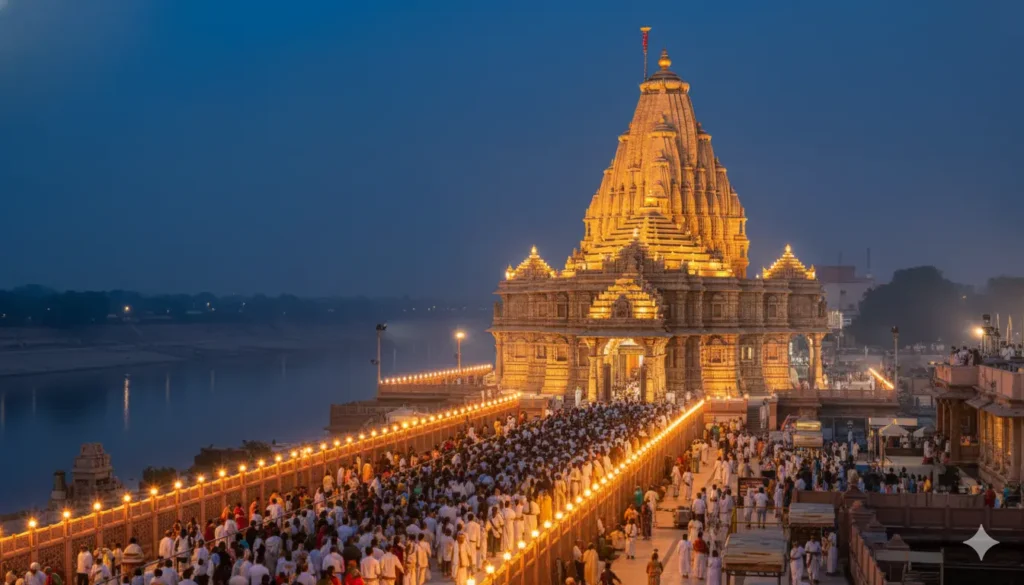
On October 11, 2022, Prime Minister Narendra Modi inaugurated the first phase of the Shri Mahakal Lok — a 900-metre pedestrian corridor connecting the Mahakaleshwar Temple to the Rudrasagar Lake. It is the third major Jyotirlinga site to receive this scale of infrastructure upgrade after Kashi Vishwanath Corridor in Varanasi and the Kedarnath shrine in Uttarakhand. Mahakal Lok is four times larger than the Varanasi corridor and has expanded the temple complex from 2 hectares to 20 hectares.
For the full corridor guide including statues, murals, VR darshan, and evening visit tips, see our dedicated Mahakal Corridor Guide.
[ Upload Image: mahakal-lok-corridor-ujjain.jpg — Alt text: mahakal lok corridor ujjain — 900-metre illuminated walkway with 108 pillars and statues at evening ]
| Feature | Details |
|---|---|
| Total length | 900+ metres |
| Large statues | 93 statues depicting stories from Shiva Purana |
| Murals | 108 murals — Shiv Vivah, Tripurasur Vadh, Shiv Tandav |
| Pillars (Stambhas) | 108 ornate pillars topped with trishuls |
| Entrance gates | Nandi Dwaar and Pinaki Dwaar |
| Project cost | ₹856 crore (Phase 1) |
| Entry fee | Free for all visitors |
| Visiting hours | 6:00 AM – 10:00 PM (last entry) |
| VR Bhasma Aarti | Available at ₹150 per person within the corridor |
| Triveni Museum | ₹20 Indians / ₹400 foreigners. Closed Tuesdays. |
✅ Best time to visit the corridor: After 7:00 PM. Once the corridor lights come on, the 108 pillars and statues are bathed in warm amber light, and the reflection shimmers in the Rudrasagar Lake. Regulars say this is one of the most visually spectacular spiritual spaces in India after dark. Leave large bags at your hotel — not permitted inside the corridor.
Every Monday during Shravan month (July–August) and the first two Mondays of Bhadrapada, Lord Mahakal leaves his temple. This is the Mahakal Sawari — the sacred procession in which an idol of Lord Shiva is placed in a silver palanquin and carried through the streets of Ujjain by devotees, accompanied by priests, a police contingent, dhol players, and thousands of singing, dancing pilgrims.
The procession begins at Mahakaleshwar Temple with a ceremonial police salute to Rajadhiraj — the King of Kings — which is Lord Mahakal’s formal title. The route winds through the old city lanes and ends at Ram Ghat on the banks of the Shipra River, where ritual Abhishek and puja are performed. The procession then returns to the temple.
The final Sawari of the season — called Shahi Sawari or the Royal Ride — is especially grand, drawing lakhs of people from across Madhya Pradesh and neighboring states.
📌 If you are attending Bhasma Aarti on a Sawan Monday, you can stay in Ujjain through the day and witness the Sawari procession the same evening. This combination — pre-dawn aarti at 4 AM and the street procession at sunset — is something only locals and repeat visitors plan for. Most booking guides never mention it.
| Date / Occasion | What Happens | Planning Note |
|---|---|---|
| All Mondays | Dedicated to Shiva. Faster queue fill. | Book Bhasma Aarti 30 days advance at midnight |
| Sawan Mondays (July–August) | Mahakal Sawari procession every Monday. Slots gone in 90 seconds. | Book 45 days in advance. Best day to be in Ujjain. |
| Nag Panchami (August 2026) | Nagchandreshwar shrine opens — the ONLY day per year. | Arrive early. This darshan is unavailable any other day. |
| Maha Shivaratri (Feb–Mar 2027) | Largest event. 12+ lakh pilgrims. Night-long worship. | Book accommodation months ahead. |
| October – March (winter) | Best weather. Comfortable pre-dawn temperatures for Bhasma Aarti. | Ideal travel window for first-time visitors. |
| Simhastha Kumbh Mela | Once in 12 years (next 2028). Entire national Kumbh in Ujjain. | Once-in-a-generation event. |
| Who | Required | Prohibited |
|---|---|---|
| Men (Garbh Grah) | Traditionally tied dhoti only. Upper body bare. | Readymade/stitched dhoti. ANY upper garment. |
| Men (Mandapam / general) | Dhoti or traditional kurta-pyjama. | Jeans, trousers, shorts, shirts, T-shirts. |
| Women (all areas) | Cotton saree. | Salwar kameez, leggings, jeans, western wear. |
✅ Where to buy a dhoti in Ujjain: Shops in the lanes leading to the temple and near Mahakal Lok sell cotton dhotis from ₹80–₹150. Buy the 5-metre traditionally tied variety — not the readymade elastic-waist version, which is rejected at Garbh Grah entry.
| Item | Rule |
|---|---|
| Mobile phones & cameras | Not allowed in main temple or during Bhasma Aarti. Free lockers near entrance. |
| Leather items | Belts, leather wallets, leather shoes — deposit at locker |
| Bags and backpacks | Not permitted past the second security checkpoint |
| Smartwatches / fitness bands | All electronic devices — remove before entry |
| Polythene bags | Banned throughout the entire temple complex |
The nearest airport is Devi Ahilyabai Holkar Airport in Indore, approximately 56 km from the temple. Indore is well-connected to Delhi, Mumbai, Bengaluru, Hyderabad, Kolkata, and Chennai with multiple daily flights. From Indore Airport, a cab takes approximately 1 hour 10 minutes to Ujjain. For a reliable, comfortable cab from Indore Airport to Ujjain, see our Indore Airport to Ujjain cab guide.
Ujjain Junction has direct connections to Delhi (Malwa Express, Mahakal Express), Mumbai, Indore (30 minutes), Bhopal (3 hours), and Vadodara. The station is 2 km from the temple — a 10-minute auto-rickshaw ride. Autos charge approximately ₹50–80 to the temple gate. Vehicles cannot go all the way to the entrance due to pedestrian restrictions near Mahakal Lok — expect to walk the last 200–400 metres.
| From | Distance | Time | Recommended |
|---|---|---|---|
| Indore | 56 km | 1 hr 10 min | Taxi / bus |
| Bhopal | 183 km | 3 hrs | Taxi / train |
| Ahmedabad | 395 km | 5.5 hrs | Bus / train |
| Nagpur | 504 km | 7 hrs | Train preferred |
| Mumbai | 660 km | 10 hrs | Train preferred |
| Delhi | 773 km | 10–11 hrs | Train preferred |
Directly above the main sanctum on the first floor — a complete Jyotirlinga shrine in its own right. No separate ticket required. Many devoted pilgrims consider the Mahakaleshwar visit incomplete without also receiving darshan here.
Open only on Nag Panchami. Houses the extraordinary idol of Shiva and Parvati seated on the ten-hooded serpent king Takshaka. Considered one of the finest ancient sculptures in central India. If your visit coincides with Nag Panchami, do not miss this.
Located behind the Ram Temple within the complex. One of the 18 Maha Shakti Peethas — the spot where Goddess Sati’s upper lip is said to have fallen. The deity is Avantika, the patron goddess of Ujjain city. This shrine is primarily visited by local devotees and is almost always bypassed by outside pilgrims.
A 10-minute walk from the temple. The Sandhya Aarti at Ram Ghat every evening — priests on floating platforms with oil lamps, sound carrying across the river — is one of the most moving experiences in Ujjain. Free. No booking. Every day.
The temple opens at 4:00 AM and closes at 11:00 PM daily. General darshan is available from 6:00 AM after the Bhasma Aarti concludes. The Bhasma Aarti runs from 4:00 AM to 6:00 AM and requires advance booking. Bhog Aarti is at 10:30 AM and Sandhya Aarti is at 7:30 PM — both free and open to all. For the full Mahakal temple timings schedule including seasonal variations, see our dedicated page.
General darshan is free and requires no booking — walk in during temple hours. Bhasma Aarti requires mandatory advance online booking (₹200/person, opens 30 days before at midnight on shrimahakaleshwar.com). Sheeghra Darshan (₹250) and Garbh Grah Darshan (₹750) can be booked online or at the counter, subject to availability.
General darshan takes 30 minutes to 4 hours depending on the day. On weekday mornings between 6:00 AM and 8:00 AM, wait times are typically 30–60 minutes. On Mondays and during festivals, expect 2–6 hours. Sheeghra Darshan reduces this significantly. Bhasma Aarti with arrival by 3:00 AM and the full 2-hour ritual takes approximately 3–4 hours total.
Mahakal darshan refers to viewing the Shivlinga — available throughout the day during temple hours. Bhasma Aarti is a specific pre-dawn ritual at 4:00 AM where sacred ash is applied to the Shivlinga by a Naga Sadhu. Bhasma Aarti requires advance booking and is far more spiritually significant. You can have darshan any day; witnessing the Bhasma Aarti requires planning months ahead. Read our complete Bhasma Aarti timing guide for details.
Visit shrimahakaleshwar.com and check the calendar under “Bhasm Aarti (Left Over Slots).” Orange dates indicate availability. For general darshan, no check is needed — the temple is open daily.
Yes. Foreign nationals are welcome for all darshan types including Bhasma Aarti. Carry your passport as valid ID. The same dress code applies to all devotees regardless of nationality. A small additional fee may apply for foreign nationals.
For general darshan, traditional Indian attire is strongly recommended. For Bhasma Aarti mandapam entry, men must wear dhoti and women must wear saree. For Garbh Grah / Jalabhishek, men must wear a traditionally tied dhoti with no upper garment — readymade stitched dhotis are not accepted. Dhotis can be bought near the temple for ₹80–₹150.
This page is part of our complete Mahakaleshwar darshan resource. Each guide below covers its topic in full detail:
Disclaimer: BhasmaArtiBooking.com is an independent informational platform. We do not provide, facilitate, or charge for temple darshan or Bhasma Aarti bookings. All bookings are managed solely by the official Mahakaleshwar Temple authorities through shrimahakaleshwar.com. Information in this guide reflects data accurate as of March 2026. Always verify timings, prices, and temple policies at the official state government portal before your visit.