Phone:
(701)814-6992
Physical address:
6296 Donnelly Plaza
Ratkeville, Bahamas.

Phone:
(701)814-6992
Physical address:
6296 Donnelly Plaza
Ratkeville, Bahamas.

| Detail | Info |
| Location | Ujjain, Madhya Pradesh, India |
| Deity | Lord Shiva (Mahakaleshwar — one of 12 Jyotirlingas) |
| Corridor Name | Mahakal Lok (Shri Mahakal Mahalok Corridor) |
| Inaugurated | October 11, 2022 (Phase 1) by PM Narendra Modi |
| Total Area | Approximately 900 meters stretch, 10.83 hectare project |
| Nearest Railway Station | Ujjain Junction (2 km) |
| Nearest Airport | Devi Ahilya Bai Holkar Airport, Indore (55 km) |
| Best Time to Visit | October to March |
| Entry Fee | Free (Temple entry — no charge) |
| Bhasma Aarti Timing | Approximately 4:00 AM (pre-booking mandatory) |
| Temple Open Hours | 3:00 AM – 11:00 PM (general darshan) |
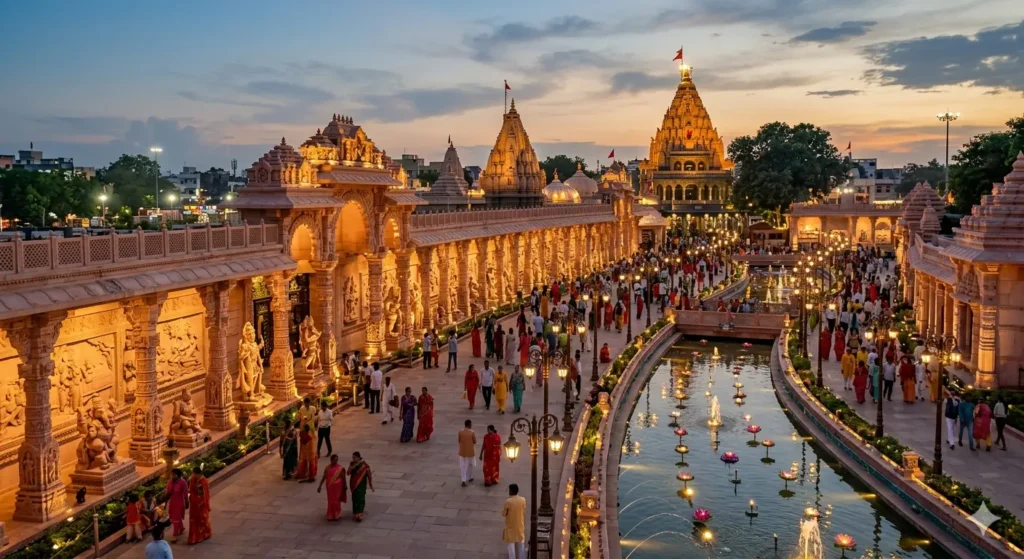
Ujjain has always been one of India’s most sacred cities — the city of Lord Mahakal, where time itself is said to originate. But in October 2022, something changed. The inauguration of the Mahakal Lok Corridor transformed not just the approach to the Mahakaleshwar temple, but the entire experience of visiting one of Hinduism’s most revered shrines.
Stretching approximately 900 meters and encompassing over 10.83 hectares of redeveloped sacred space, the Mahakal Corridor is one of the largest religious infrastructure projects in India’s recent history. It brings together ancient mythology, spectacular sculpture, modern crowd management, and the raw spiritual energy that has drawn pilgrims to Ujjain for thousands of years.
Whether you are a devout pilgrim coming to seek the blessings of the only Jyotirlinga where Lord Shiva faces south — a direction associated with death and transcendence — or a curious traveler exploring India’s spiritual heritage, this guide covers everything you need to plan your visit in 2026.
Mahakaleshwar is one of the 12 Jyotirlingas — the most sacred shrines of Lord Shiva in Hindu tradition. Among these twelve, Mahakaleshwar holds a uniquely elevated position for several reasons:
The name Mahakal combines “Maha” (great) and “Kal” (time/death). Lord Mahakal is the deity who transcends and governs time itself. In a tradition where the cyclical nature of creation and destruction is fundamental, worshipping at Ujjain is believed to bring liberation from the cycle of birth and death.
The city appears in ancient texts including the Mahabharata, the Puranas, and Kalidasa’s celebrated poem Meghaduta — in which the poet describes Ujjain as a city so sacred that even clouds pause to pay homage as they pass over it.
Before the corridor’s construction, the approach to the Mahakaleshwar temple was a dense, unplanned maze of narrow lanes, commercial stalls, and uncontrolled crowds. For one of India’s most visited religious sites — receiving millions of pilgrims annually — the infrastructure had not kept pace with the scale of devotion.
The Mahakal Lok project was conceived to:
Phase 1 (Inaugurated October 2022):
Phase 2 (Ongoing development):
The most extraordinary aspect of the Mahakal Corridor for many visitors is not the scale of the construction but the storytelling embedded within it. The corridor is essentially a 3-dimensional illustrated scripture — a walk through the most important narratives of Lord Shiva’s mythology.
Shiva Tandava The iconic cosmic dance of destruction and recreation. The Nataraja form of Shiva depicted along the corridor captures the philosophical concept that destruction is inseparable from renewal — the foundation of Shaivite cosmology.
The Marriage of Shiva and Parvati Detailed sculptural panels depicting the divine wedding — one of Hinduism’s most beloved narratives — including the Baraat (wedding procession) with all its mythological participants including Nandi, Ganas, and the full assembly of divine beings.
Tripurantaka — The Destroyer of Three Cities Shiva as the cosmic archer who destroyed the three aerial cities (Tripura) of the asuras — a powerful narrative of good over evil rendered in dramatic sculptural form.
Shiva as Neelkanth The famous episode from the Samudra Manthan (churning of the cosmic ocean) where Shiva drinks the poison Halahala to save creation, his throat turning blue. One of the most emotionally resonant stories in Hindu tradition.
The Twelve Jyotirlingas Sculptural representations of all twelve Jyotirlinga shrines — allowing pilgrims who cannot travel to all twelve to receive symbolic darshan of each at a single location.
Saptarishi and Navagraha The seven great sages and nine planetary deities rendered in stone, acknowledging the cosmic and astrological significance of Ujjain as the ancient prime meridian of Indian astronomy.
The Mahakaleshwar temple is a masterpiece of Maratha-period temple architecture, built and rebuilt across centuries with the current structure reflecting significant 18th-century reconstruction. The five-storeyed temple tower (shikhara) rises dramatically above the surrounding complex.
The temple complex contains multiple shrines within its precincts:
| Darshan Type | Timing | Notes |
| General Darshan | 3:00 AM – 11:00 PM | Free, open to all |
| Bhasma Aarti | ~4:00 AM | Pre-booking mandatory |
| Morning Aarti (Naivedya) | ~7:30 AM | Open viewing |
| Afternoon Aarti (Bhog) | ~10:30 AM | Open viewing |
| Evening Aarti (Sandhya) | ~5:30 PM | Open viewing |
| Night Aarti (Shayan) | ~10:30 PM | Open viewing |
Note: Timings can vary by season and festival periods. Always verify current timings through the official temple website or Ujjain Mahakal Temple management before your visit.
Bhasma Aarti is the most unique and sought-after ritual at Mahakaleshwar — and arguably one of the most extraordinary religious ceremonies in India. It takes place in the pre-dawn hours, typically around 4:00 AM.
The ritual involves the anointing of the Mahakaleshwar lingam with bhasma — sacred ash — in an elaborate, ancient ceremony performed by the temple’s hereditary priests. The tradition holds that Lord Mahakal himself is smeared with bhasma, symbolizing his identity as the lord of cremation grounds and his transcendence of the physical world.
Bhasma traditionally used in this ceremony carries deep philosophical meaning — ash is what remains after fire consumes matter, representing the ultimate truth that all physical existence is temporary. To witness this ceremony in the pre-dawn darkness, with the chanting of Vedic mantras filling the sanctum, is described by pilgrims as one of the most spiritually transformative experiences available in India.
Booking is mandatory — walk-in is not permitted.
| Booking Method | Details |
| Online | Official MP Tourism / Mahakal Temple website |
| Offline | Temple counter in Ujjain (subject to availability) |
| Advance booking | Recommended 1–2 weeks ahead, especially Oct–March and festival periods |
| ID proof | Mandatory — carry original government ID matching the booking name |
| Dress code | Traditional Indian attire strongly recommended; inappropriate clothing may result in entry refusal |
| Photography | Strictly prohibited inside the sanctum during Bhasma Aarti |
Ujjain is not just Mahakaleshwar — it is a city that has been continuously sacred for over 2,000 years. A complete visit should include:
One of the most fascinating temples in India. Kal Bhairav is the fierce guardian deity of Ujjain and a form of Shiva associated with time and justice. What makes this temple extraordinary is the prasad offered to the deity — liquor. Bottles of wine and spirits are offered to the Kal Bhairav idol and believed to be consumed by the deity. The temple draws both devotees and curious visitors from around the world.
The most sacred bathing ghat on the Shipra river in Ujjain. Ram Ghat is where the Kumbh Mela (Simhastha) — one of the largest human gatherings on earth — takes place every 12 years. The ghat’s evening aarti, with oil lamps floated on the river as the sun sets, is one of Ujjain’s most visually beautiful experiences. The next Simhastha Kumbh Mela in Ujjain is scheduled for 2028.
An important Shakti Peeth — one of the sacred sites associated with the goddess Sati. The temple’s two large oil lamp pillars (deepstambha) are particularly striking when lit during Navratri festivals.
Considered the birthplace of Mars (Mangal) in Hindu tradition. Particularly significant for devotees seeking astrological remedies related to Mangal Dosha. The temple sits on elevated ground with a panoramic view of Ujjain.
The historic ashram where, according to tradition, Lord Krishna, Balaram, and Sudama studied under the sage Sandipani. The ashram contains a stone slab believed to be the original writing board used during their education.
One of the five astronomical observatories built by Maharaja Jai Singh II in the 18th century. Ujjain’s observatory reflects the city’s ancient status as the prime meridian of Indian astronomical calculation. A fascinating site for those interested in the intersection of science and spirituality.
One of the most ancient Ganesh temples in India, believed to be Swayambhu (self-manifested). A visit here before the main Mahakal darshan is considered auspicious by local tradition.
The nearest airport is Devi Ahilya Bai Holkar Airport in Indore — approximately 55 km from Ujjain. From Indore airport, taxis and cabs are readily available to Ujjain (approximately 1–1.5 hours by road).
Ujjain Junction is a major railway station with direct connectivity to most major Indian cities:
| Route | Approximate Journey Time |
| Mumbai to Ujjain | 12–14 hours |
| Delhi to Ujjain | 12–15 hours |
| Indore to Ujjain | 1.5–2 hours |
| Bhopal to Ujjain | 2.5–3 hours |
| Ahmedabad to Ujjain | 6–8 hours |
Ujjain Junction is located approximately 2 km from the Mahakal Temple — easily accessible by auto-rickshaw or e-rickshaw.
Ujjain is well connected to the national highway network:
State buses (MPSRTC) operate regular services from Indore, Bhopal, and other major Madhya Pradesh cities. Private cabs and inter-city taxis are widely available.
Numerous dharamshalas (pilgrim rest houses) and budget hotels are available within walking distance of the Mahakal temple. Options managed by temple trusts and religious organizations offer clean, basic accommodation specifically for pilgrims.
Several well-maintained hotels are available within 1–3 km of the temple complex offering modern amenities, clean rooms, and proximity to the corridor.
Ujjain’s premium accommodation options have expanded significantly since the corridor’s inauguration. Several branded hotel properties now operate in the city, offering higher-comfort options for visitors who prioritize amenities alongside their pilgrimage.
Ujjain experiences extremely high demand during:
| Season | Months | Experience |
| Best | October – March | Pleasant weather (15–25°C), comfortable for walking the corridor |
| Good | April – June | Hot (35–42°C) but manageable with early morning visits |
| Challenging | July – September | Monsoon — heavy rain but spiritually significant Sawan month |
Mahashivratri (February/March) The most important festival at Mahakaleshwar. The temple and corridor are spectacular but crowds are at their absolute peak — lakhs of devotees over multiple days. An extraordinary spiritual experience but requires significant advance planning.
Sawan Somvar (July/August Mondays) Every Monday during the holy month of Sawan sees enormous crowds of Kanwariyas (Shiva devotees) and regular pilgrims. The energy is extraordinary, the waits are long.
Nag Panchami The one day of the year when the topmost Nagchandreshwar temple — normally closed — opens for public darshan. Creates significant crowd surge.
The Mahakal Corridor has implemented sophisticated crowd management systems including:
Is there an entry fee for the Mahakal Corridor or temple? No. Entry to both the Mahakal Lok Corridor and the Mahakaleshwar temple itself is completely free. Bhasma Aarti requires a booking (a nominal fee may apply — verify current rates on the official website). Special darshan passes for faster queue access are available for a fee.
How long does a complete visit take? A complete visit — walking the full corridor, general darshan, and exploring the temple complex — takes approximately 3–5 hours. If you include Bhasma Aarti (which starts at 4:00 AM), plan for an early morning start. Adding other Ujjain sites makes a full-day itinerary.
How far in advance should I book Bhasma Aarti? During peak seasons (October–March, Mahashivratri, Sawan) booking 2–4 weeks in advance is recommended. During quieter periods, 3–5 days ahead is usually sufficient, though early booking is always safer.
Can non-Hindus visit the Mahakal Corridor and temple? The corridor is open to all visitors regardless of faith. For the inner sanctum of the temple, entry norms are consistent with standard Hindu temple practice — visitors of all faiths are generally welcomed as long as they follow dress code and conduct guidelines respectfully.
What is the best time of day to visit the corridor? Early morning (post Bhasma Aarti until around 9:00 AM) and evening (after 6:00 PM when the corridor lighting is illuminated) are the most rewarding times. The evening lighting transforms the sculptural corridor into a spectacular visual experience. Midday in summer should be avoided due to heat.
Is the corridor accessible for elderly visitors and those with mobility challenges? Yes. The Mahakal Corridor was designed with accessibility in mind, including ramps, dedicated queues, seating areas along the promenade, and wheelchair assistance. Contact the temple management in advance for specific accessibility requirements.
What is the Simhastha Kumbh Mela and when is the next one? The Simhastha Kumbh Mela is the Kumbh Mela held at Ujjain — one of the four rotating Kumbh Mela sites in India. It occurs every 12 years when Jupiter (Brihaspati) enters the zodiac sign of Leo (Simha). The next Simhastha at Ujjain is scheduled for 2028. It is one of the largest peaceful human gatherings on earth, drawing tens of millions of pilgrims over several weeks.
Are there prasad and offering shops inside the corridor? Yes. Designated stalls for prasad, flowers, and puja materials are available within the corridor complex. The project has specifically allocated spaces for local vendors and artisans as part of the broader economic development vision.
| Time | Activity |
| 3:30 AM | Arrive at temple for Bhasma Aarti (pre-booked) |
| 4:00–5:00 AM | Bhasma Aarti — the highlight of any Ujjain visit |
| 5:00–7:00 AM | Walk the Mahakal Corridor at dawn — most peaceful time |
| 7:30 AM | Morning Aarti darshan |
| 9:00 AM | Breakfast at a local restaurant near the temple |
| 10:00 AM | Kal Bhairav Temple |
| 11:30 AM | Ram Ghat — Shipra river walk |
| 1:00 PM | Lunch and rest |
| 3:00 PM | Sandipani Ashram and Vedh Shala |
| 5:30 PM | Evening Sandhya Aarti at Mahakaleshwar |
| 6:30 PM | Mahakal Corridor evening walk — illuminated sculptures |
| 8:00 PM | Dinner and departure or overnight stay |
Day 1: Follow the one-day itinerary above
Day 2:
The Mahakal Lok Corridor is more than a tourism infrastructure project. At its best, it is an attempt to create a sacred space that matches in grandeur and thoughtfulness the spiritual magnitude of what it approaches.
For the pilgrim, it provides a worthy processional approach to one of Hinduism’s supreme shrines — a transition from the ordinary world to the sacred one that ancient temple architects understood as essential to genuine religious experience.
For the traveler, it is one of the most spectacular examples of mythological storytelling rendered in public space anywhere in India — a 900-meter walk through the living heart of a 5,000-year-old tradition.
Ujjain has always been the city of Mahakal — the city where time itself bows before the eternal. The corridor simply makes that truth visible to all who walk through it.
Visiting information, timings, and booking processes are subject to change. Always verify current details through the official Mahakaleshwar Temple website or MP Tourism before your visit.