Phone:
(701)814-6992
Physical address:
6296 Donnelly Plaza
Ratkeville, Bahamas.

Phone:
(701)814-6992
Physical address:
6296 Donnelly Plaza
Ratkeville, Bahamas.

| ⚡ Quick Answer — Bhasma Aarti Timing at Mahakaleshwar The Bhasma Aarti at Mahakaleshwar Temple, Ujjain starts every day at 4:00 AM and concludes by 6:00 AM. This is the first and most sacred ritual of the day. The Jal Abhishek (water offering) that precedes it begins at 3:15 AM. Temple gates open for Bhasma Aarti devotees at 2:30 AM. ⏰ Gates Open: 2:30 AM 🙏 Jal Abhishek: 3:15 AM – 4:00 AM Bhasma Aarti: 4:00 AM – 6:00 AM 📍 Temple: Mahakaleshwar Jyotirlinga, Ujjain, Madhya Pradesh 🎟️ Book at: bhasmaartibooking.com ⚠️ Booking is mandatory — walk-ins are NOT allowed inside the sanctum |
I was born and raised in Ujjain. I grew up two lanes away from the Mahakaleshwar Temple. My grandmother used to say that if you’ve lived your whole life in Ujjain and never sat inside that hall during the Bhasma Aarti, you’ve missed the entire point of living here. As a kid, I thought she was being dramatic. Then I attended my first Bhasma Aarti at the age of twelve, and I understood exactly what she meant.
I have since attended this aarti more than two hundred times. I’ve been there in the biting cold of January, in the humidity of monsoon August, during Maha Shivratri when you can barely move, and on quiet Tuesday mornings when it felt like just me and Baba Mahakal. I know every corner of this ritual — the sounds, the smells, the moments when the atmosphere suddenly shifts and you feel something that you cannot explain in words.
So let me give you the kind of guide that a local would give their own family member visiting for the first time. Not just timings and dress codes — those are easy to find. I’m going to tell you the things that Google doesn’t know, the secrets that don’t make it onto official websites, and the mistakes that I see first-time visitors make every single week.
| Ritual / Event | Timing |
| Temple gates open for Bhasma Aarti | 2:30 AM |
| Jal Abhishek (Garbhagriha access) | 3:15 AM – 4:00 AM |
| Bhasma Aarti begins | 4:00 AM sharp |
| Bhasma Aarti concludes | ~6:00 AM |
| Morning Darshan opens (general) | 6:00 AM |
| Bhog Aarti (mid-morning offering) | 10:30 AM – 11:15 AM |
| Afternoon Darshan pause | 1:00 PM – 3:00 PM (summer) |
| Sandhya Aarti (evening) | 6:30 PM – 7:30 PM |
| Shayan Aarti (night closure ritual) | 10:30 PM – 11:00 PM |
| Temple closes for the night | 11:00 PM |
| 📌 Important — Winter vs Summer Timing Shift The temple operates on two seasonal calendars: Winter Schedule: Kartik Shukla Pratipada to Falgun Shukla Purnima (Approximately October 8 to March 3 each year) Summer Schedule: Chetra Krishn Pratipada to Ashwin Shukla Purnima (Approximately March 4 to October 7 each year) The Bhasma Aarti itself stays at 4:00 AM year-round, but general darshan timings, afternoon break hours, and some special puja slots shift between seasons. Always verify at: shrimahakaleshwar.com before your visit. |
Most articles will tell you ‘the aarti happens from 4 AM to 6 AM.’ That tells you nothing about what’s actually happening inside that sanctum. Let me walk you through it the way I’ve experienced it hundreds of times.
2:30 AM — The City Stirs
The narrow lanes around the Mahakaleshwar Temple are already moving at 2:30 AM. Small tea shops near the temple gate open with a single gas flame and a pot of chai. Devotees who’ve traveled overnight from distant cities sit on the stone steps, wrapped in shawls, holding their booking passes and ID proofs. The air smells of incense, wet stone, and marigolds left from yesterday’s offerings.
Security begins at the main gates. Your pass is checked, your ID is verified. Men with dhotis step to the left lane; women in sarees to the right. Any leather items — wallets, belts, bags — are deposited at the locker. Mobile phones go here too. And I mean all electronics. That fitness band on your wrist? Leave it in the locker. Security has gotten sharper in recent years and they do check.
3:00 AM — The Queue Forms Inside
By 3 AM, the inner corridors of the temple are filling with a quiet, reverent crowd. Nobody speaks loudly. You can hear sandals scraping on ancient stone, the distant sound of a bell being struck somewhere deep inside, and the low murmur of people softly repeating ‘Om Namah Shivaya.’ This is one of those moments when even the most skeptical first-time visitor tends to go quiet.
The queue moves based on your booking category — Nandi Mandapam (closest, around 24 seats directly facing the sanctum), Ganapati Mandapam (next level, comfortable seating), Kartikeya Mandapam (further back but still inside), and the open barricade area outside the Nandi Hall which can seat 500+ people. VIP passes get Nandi Mandapam priority.
3:15 AM — Jal Abhishek Begins
This is the part that most people don’t realize is separate from the main aarti. The Jal Abhishek is the ritual bathing of the Shivalinga with water, and it begins at 3:15 AM. If you’re booked for Jal Abhishek participation (which requires the full traditional dress — tied dhoti for men, no readymade dhoti is allowed inside Garbhagriha), you enter the sanctum in batches.
Men can physically touch and pour water on the Shivalinga. Women stand at the threshold of the Garbhagriha. You bring your lota (a small metal vessel — borrow one near the entry point if you don’t have one). Fill it with the water provided near the entrance. Walk forward. The Shivalinga rises from a silver platform, dark and sacred, surrounded by the fragrance of bilva leaves and fresh flowers. Pour slowly. The priests guide you. This entire sequence takes about 5 minutes per person but the feeling stays for a lifetime.
The Jal Abhishek closes at 4:00 AM sharp to prepare for the main aarti. If you’re inside after that, you are moved to your designated seating area.
4:00 AM — The Bhasma Aarti Begins
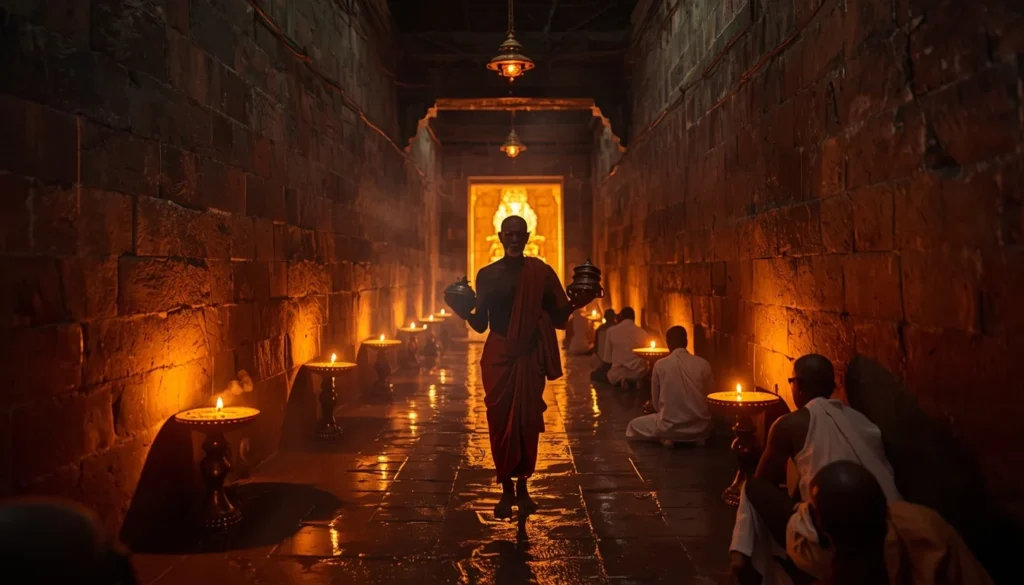
The lights in the sanctum dim. Not because someone flips a switch — it happens gradually as the oil lamps take over. A conch shell sounds, deep and resonant, and the sound bounces off the ancient walls in a way that vibrates in your chest. This is the moment.
The Bhasma Aarti is performed exclusively by the saints and mahants of the Shri Mahanirvani Akhara — one of India’s oldest monastic orders, with authority over this temple going back centuries. No other priest performs this ritual. No one else applies the bhasma.
The bhasma itself — and this is something many people don’t know — was traditionally made from the cremation ashes of the deceased (symbolic of Shiva’s dominion over death and time). In current practice, the bhasma is prepared from dried cow dung that is ritually processed, mixed with sacred ash, and consecrated through a detailed Vedic procedure. The Naga Sadhus who participate in the ceremony carry this bhasma in traditional vessels.
Vedic mantras fill the air in a continuous stream. Damroos are struck. Ghee lamps are swung in slow arcs before the Shivalinga. The ash is applied to the lingam with deliberate, practiced movements. The entire ritual has a choreography that has remained essentially unchanged for over a thousand years.
If you are seated in the Nandi Mandapam — directly in front, maybe eight to ten feet from the sanctum entrance — you can see everything. Every movement of the priests’ hands, the shimmer of the oil lamps on the silver platform, the silver cobra hood above the Shivalinga. For those seated further back, the experience is more about sound, atmosphere, and the collective devotional energy of hundreds of people in complete silence and focus.
The aarti concludes sometime around 5:30 to 6:00 AM, depending on the day and any special rituals that are added. After the aarti, prasad is distributed — sacred ash that you can receive in your palm and apply to your forehead. Most people wait for this moment even longer than they wait for the aarti itself.
These are the things I’ve learned from years of attending, from talking to the purohits, from watching first-time visitors make the same mistakes, and from the kind of knowledge that only gets passed down in person.
Secret #1 — The Dhoti Rule That Gets People Rejected at the Gate
This one catches people every single time. The dress code says ‘dhoti for men.’ What it doesn’t spell out is that the dhoti must be manually tied — not a readymade, stitched, elastic-waist dhoti. Readymade dhotis are available in every shop near the temple and they look fine, but if you try to enter the Garbhagriha for Jal Abhishek wearing one, you will be turned away at the final check.
The reason, as explained to me by one of the senior temple volunteers, is rooted in an ancient purity principle — stitched cloth is considered tailor-made (silai), which traditionally is not permitted in certain sacred spaces. A traditionally tied dhoti (the five-meter white cotton variety you wrap and tuck) is the only accepted option for Garbhagriha entry.
For Bhasma Aarti viewing from the Nandi Hall or outer mandapams, this strict rule relaxes a bit — you can watch the aarti in regular traditional Indian attire. But if you’re going inside for Abhishek, get the right dhoti. The shops right outside the temple sell them and the shopkeepers will show you how to tie it if you ask.
Secret #2 — The Booking Window Opens at Midnight
Slots for Bhasma Aarti open exactly 30 days in advance at 12:00 AM midnight (for standard categories). VVIP categories open 45 days in advance. This is not widely publicized, but if you try booking at 9 AM for a popular date, you’ll often find the slots are already gone.
Set a reminder for 11:55 PM on the night that falls exactly 30 days before your planned visit. Have your Aadhaar and passport-sized photo scanned and ready to upload. The government website (shrimahakaleshwar.com) can be slow at midnight due to traffic — keep refreshing. For particularly popular dates like Maha Shivratri, the VVIP window opens 45 days before the date at midnight — this is the only window for the closest sanctum access on that day.
Secret #3 — The Confirmation SMS Comes Late (and People Panic)
When you submit your offline booking application at the temple counter (available between 10 AM and 3:30 PM the day before your aarti), you’ll receive a computerized receipt. The official confirmation SMS — which tells you whether your slot has been granted — is not sent immediately. It comes between 7:30 PM and 10:30 PM on the same evening. The list is declared at 5:00 PM inside the temple, but the SMS reaches you hours later.
First-time visitors often panic when they don’t receive a confirmation by evening. Don’t. Go for dinner, relax, and check your phone after 8 PM. If you’re still worried by 10:30 PM, go to the temple counter directly and ask to verify your name on the confirmed list.
Secret #4 — Monday and the Shravan Window That Most People Miss
Every Monday is considered especially sacred for Lord Shiva, and Monday Bhasma Aarti slots fill up faster than any other weekday. But here’s what most people don’t know: during the Shravan month (July–August), Lord Mahakal’s palanquin procession (Sawari) moves through the streets of Ujjain every Monday. This is a completely separate, spectacular event that happens in the evening — and it’s free, open to the public, and wildly beautiful.
If you’re visiting Ujjain during Shravan and you can only attend one event, the Monday Sawari through the city’s lanes at sunset is something that will move you even if you’re not religious. Thousands of people line the streets, throwing flowers, playing music, burning incense. Mahakal rides through his own city in full royal procession. It’s the kind of thing you don’t read about in travel guides.
Secret #5 — Children Under 12 Don’t Need a Booking
This is official policy but not clearly communicated. Children below 12 years of age do not need a separate booking for Bhasma Aarti — they can accompany an adult with a valid booking. Many families unnecessarily stress over booking for small children. Just carry your child’s Aadhaar or school ID as a backup (some entry staff ask for it), but technically no booking is required for under-12s.
Secret #6 — The Best Seat Is Not Nandi Mandapam
Okay, this will surprise people who’ve spent ₹200 extra for VIP Nandi Mandapam access. The Nandi Mandapam is directly in front of the sanctum, yes — but it fits only about 24 people, seating is extremely tight, and because you’re so close to the priests, the view is sometimes partially obstructed by the ritual proceedings themselves.
Many experienced devotees — including locals who attend regularly — actually prefer the Ganapati Mandapam, which offers a slightly elevated, wider view of the entire sanctum entrance. You see the complete picture rather than just a narrow frame. If the Nandi Mandapam is full or unavailable, don’t be disappointed. The Ganapati Mandapam experience is genuinely excellent.
Most visitors only know about the Bhasma Aarti and miss everything else. Here’s the complete daily ritual schedule with what each aarti actually involves:
| Aarti Name | Time & What Happens |
| 1. Bhasma Aarti | 4:00 AM – 6:00 AM | Sacred ash applied to Shivalinga; Vedic mantras; most sacred aarti of the day. Advance booking mandatory. |
| 2. Naivedya Aarti (Bhog) | 10:30 AM – 11:15 AM | Food offerings presented to the deity. General public darshan continues before and after. More accessible, no advance booking needed. |
| 3. Madhyanh Aarti | ~12:00 PM | Mid-day ritual; temple may have reduced access. Short but significant. |
| 4. Sandhya Aarti | 6:30 PM – 7:30 PM | Evening ritual with diyas and flowers. The atmosphere is beautiful, especially in winter. One of the most visually stunning aartis. |
| 5. Shringaar Aarti (Shringar) | ~7:30 PM – 8:00 PM | Lord Mahakal is adorned with flowers, jewels, and special decorations. Separate booking required; limited access. |
| 6. Shayan Aarti | 10:30 PM – 11:00 PM | Night ritual ‘putting the Lord to sleep’. Temple closes after this. Peaceful, smaller crowd. |
| 💡 Local Tip — The Sandhya Aarti Is Underrated If you cannot wake up for the 4 AM Bhasma Aarti, or if your slot wasn’t available, do NOT leave Ujjain without attending the Sandhya Aarti at 6:30 PM. No booking needed. Just arrive at the temple by 6:00 PM, join the queue, and find a spot in the outer mandapam. When those lamps start swinging and the whole hall fills with the sound of bells and conch, it’s genuinely moving. Local families come for the Sandhya Aarti the way people elsewhere go for evening walks — it’s part of daily life here. And it’s completely free. |
Online Booking (Recommended — Do This)
The official website is shrimahakaleshwar.com. There are unfortunately some third-party sites that claim to offer booking services — some are legitimate aggregators, but many are not authorized. The only official source is the temple’s own website or bhasmaartibooking.com for guided assistance with the process.
| ⚠️ Critical Warning — Name Matching The single most common reason for entry denial is a mismatch between the name on the booking form and the name on the ID card. Even a minor spelling difference ‘Ramesh’ vs ‘Ramesh Kumar’ — can cause problems at the security gate. Enter your name EXACTLY as it appears on your Aadhaar card. If your name has changed (marriage, etc.), use your current legal ID that matches the name you’ve entered in the booking form. Double-check before submitting. Also: PAN cards are NOT accepted as ID proof. Use Aadhaar, Passport, or Voter ID. |
Offline Booking (For Last-Minute Plans)
If you’re already in Ujjain and didn’t book online, there’s still a chance. The offline booking counter (Mahakal Pravachan Hall, near the main temple gate) issues a limited number of passes the day before the aarti. Counter timings: 10:00 AM to 3:30 PM.
Arrive by 9:30 AM if possible — the queue starts forming before the counter opens, and available slots are assigned on a first-come, first-served basis. The confirmed list is posted at 5:00 PM. Your confirmation SMS comes between 7:30 PM and 10:30 PM. If you’re not on the list, you will not be permitted inside the sanctum — but you can still watch from the outer area if you arrive early enough on the morning of the aarti.
This section alone can save you a lot of trouble at the gate. I’ve watched people get turned back after traveling hundreds of kilometers because they had the wrong item or didn’t have the right one. Let me make this very clear.
Bring These
Absolutely Do NOT Bring
The official answer is ‘before 4 AM.’ The real answer, from someone who has done this many times, is more nuanced.
| If Your Goal Is… | Arrive By… |
| Jal Abhishek inside Garbhagriha | 2:30 AM (gates open) — queue starts filling immediately |
| Nandi Mandapam seating (VIP, front row) | 2:45 – 3:00 AM at the latest |
| Ganapati or Kartikeya Mandapam | 3:00 – 3:30 AM should be fine on non-festival days |
| Outer barricade / general viewing | 3:30 – 3:45 AM on regular days; 2:30 AM on festivals |
| Maha Shivratri / Monday in Shravan | 2:00 AM minimum — ideally reach the gate area by 1:30 AM |
| Peak festival period (any major date) | 1:00 – 1:30 AM; some devotees queue from midnight |
| 🏨 Most Important Local Advice — Stay Near the Temple I cannot stress this enough. Book a hotel or dharamshala within walking distance of Mahakaleshwar Temple. Not 2 km away. Walking distance. Here’s why: at 2:30 AM, vehicles are not permitted near the temple in most of the surrounding lanes. Auto-rickshaws will drop you at a checkpoint and you’ll walk the rest. If your hotel is a 15-minute walk from the temple, that means leaving at 2:15 AM. If it’s 30 minutes away, you leave at 2:00 AM. Options within 5-minute walk: Shri Mahakal Dharamshala (affordable), Hotel Shipra Residency (mid-range), and several guesthouses on Freeganj Road. Book these FIRST, then plan the rest of your Ujjain trip around them. Bonus: Staying close means you can hear the temple bells in the morning and evening from your room. That’s an experience in itself. |
| Category | Price & What You Get |
| General Bhasma Aarti (Barricade Area) | Free / ₹100 — Outer viewing area, 500+ capacity, no guaranteed spot near sanctum |
| Standard Booking (Mandapam) | ₹100–₹200 — Ganapati or Kartikeya Mandapam, good view, advance booking opens 30 days prior |
| VIP Bhasma Aarti (Nandi Hall) | ₹200–₹250 — Closest to sanctum, front view, limited to ~24 people, books fastest |
| Garbhagriha Darshan + Jal Abhishek | ₹500–₹750 — Physical entry into sanctum, touch the Shivalinga (men only), earliest entry at 3:15 AM |
| VVIP / Special Category | ₹1,500+ — Extremely limited, booking opens 45 days in advance, sanctum-level proximity |
| Children under 12 years | No booking required — accompany parent with valid booking |
| 🔖 Note on Prices Temple fees are set by the Shri Mahakaleshwar Temple Management Committee (a government body) and can be revised periodically. Always verify current fees at the official website before booking. The prices above reflect 2025–2026 rates and may vary slightly by season or for special occasions. No booking fees or commissions are charged by the official website. If any third-party charges an ‘arrangement fee’, make sure you know what service they are actually providing before paying. |
You’ve attended the Bhasma Aarti, collected your prasad, and walked out into the Ujjain dawn around 6:00 AM. The city is waking up. Here’s how a local would spend the rest of that morning.
6:00 AM — Poha-Jalebi at the Gopal Mandir Stalls
The best breakfast in Ujjain costs about ₹40 and comes from the small stalls near Gopal Mandir and around the Mahakaleshwar complex. Hot poha (flattened rice cooked with onion, mustard seeds, and curry leaves) with a jalebi on the side, served on a leaf plate. There’s something about eating this after the aarti at dawn in the cold Ujjain air that is genuinely perfect. Don’t skip this.
7:00 AM — Mahakal Lok Corridor Walk
The Mahakal Lok Corridor — opened in 2022 — is a 900-meter promenade connecting the old city to the temple complex, lined with large bronze and stone sculptures depicting stories from the Shiva Purana and Mahakal mythology. In the early morning, before the tourist crowd arrives, it’s quiet and breathtaking. The light at 7 AM hits the sculptures in a way that looks like something out of a painting.
8:30 AM — Kal Bhairav Temple
This is the second-most important temple in Ujjain and something most visitors don’t understand until they’re standing in front of it. Kal Bhairav is the fierce guardian deity of the city — the tantric form of Shiva. The unique offering here is liquor. The deity literally consumes the liquor presented by devotees, and it visibly disappears in front of your eyes at the idol’s lips. I’ve seen this hundreds of times and I still cannot explain it to anyone’s satisfaction. Go see it yourself.
10:00 AM — Harsiddhi Temple
One of the 51 Shakti Peethas of India. The two lamp towers (deeptmalas) flanking the main temple are extraordinary — covered in hundreds of oil lamps that are lit on special occasions and transform the whole structure into fire. Even when not lit, the architecture alone is worth visiting. The morning light in the inner courtyard is serene.
12:00 PM — Rest, Bhog Aarti Darshan at Mahakaleshwar
Come back to Mahakaleshwar at 10:30 AM for the Bhog Aarti — no booking required, just join the regular darshan queue. Then rest. You’ve been awake since 2 AM. Your body needs it, and Ujjain’s evenings are equally beautiful and worth energy.
6:30 PM — Ram Ghat Evening Aarti
The Sandhya Aarti at Ram Ghat on the banks of the Shipra River happens every single evening, completely free. Priests stand on floating platforms with oil lamps. The sound echoes across the water. Behind you, the city hums. Above you, the sky turns from orange to deep blue. Sit on the ghat steps and just be here for a while. This is Ujjain at its most honest.
| Fun Facts From a Local 1. The Bhasma Aarti has been performed EVERY SINGLE DAY without interruption for over 1,000 years. No holiday, no weather event, no political upheaval has ever cancelled this ritual. Think about what that means — every day at 4 AM for a thousand years. 2. The Mahakaleshwar Jyotirlinga is described as ‘swayambhu’ (self-manifested) — it was not installed by human hands but believed to have emerged from the earth on its own. It is the only south-facing (dakshinamukhi) Jyotirlinga in India. All other Jyotirlingas face east or north. 3. The bhasma applied to the Shivalinga during the aarti traditionally came from cremation pyres — reinforcing Shiva’s role as Mahakal (Great Time, Lord of Death). Current practice uses ritually processed cow dung ash, but the symbolism remains profoundly unchanged. 4. Only saints of the Mahanirvani Akhara — one of India’s oldest monastic orders — are authorized to perform the Bhasma Aarti. This authority has been continuously held by this akhara for centuries, passed down through an unbroken lineage. 5. The Nandi bull sculpture inside the temple is unusually small compared to most Shiva temples. Local tradition says Nandi is perpetually crouched in deep obeisance to Mahakal — too overwhelmed by the Lord’s presence to stand tall. 6. A Quora commenter who attended the aarti for the first time from Mumbai wrote that the experience felt like ‘standing in the middle of something ancient and completely alive at the same time.’ That’s probably the most accurate description I’ve ever read from a first-timer. It’s exactly that. 7. You cannot take a single photo inside. But somehow, the memory of what you saw and felt is sharper than any photograph could ever be. |
| ⚠️ These Are Non-Negotiable at the Temple Gate 1. NO REFUND POLICY: Once your Bhasma Aarti booking is confirmed and paid, it cannot be cancelled or refunded under any circumstances. This is temple policy. Plan your travel carefully before confirming dates. 2. EACH BOOKING IS DATE-SPECIFIC: Your pass is valid for one specific date only. If you want to attend on multiple days (e.g., consecutive Mondays during Shravan), you need a separate booking for each date. 3. GATE CLOSURE IS STRICT: VIP entry gates close at 3:15–3:30 AM. If you arrive at 3:35 AM for a VIP slot, you may be denied entry regardless of your pass. The temple does not wait for latecomers. 4. NO EXCEPTIONS FOR DRESS CODE: If a man arrives for Garbhagriha entry without a properly tied dhoti, he is turned back. No argument, no exception. Women arriving in Western attire are not permitted in the inner areas. 5. ELECTRONICS POLICY HAS TIGHTENED: Even smartwatches and small bluetooth devices have been confiscated at the gate in recent years. Deposit all electronics at the free locker facility near the temple entrance. The locker is safe and free. 6. BEWARE OF SCAMMERS: Men near the temple gate sometimes approach visitors offering to ‘arrange’ VIP Bhasma Aarti entry for cash. This is a scam. Official bookings only come through shrimahakaleshwar.com. Never pay cash to anyone outside the official counter. |
Q: Can I attend the Bhasma Aarti without any booking at all?
You can enter the outer temple complex and get to the barricade area without a booking if you arrive very early — by 2:00 to 2:30 AM — and there’s space available. But entry into the Nandi Hall, Ganapati Mandapam, or the Garbhagriha requires a valid booking. If you want any kind of close viewing, book in advance. Don’t gamble on this.
Q: Is the Bhasma Aarti more powerful on certain days?
Spiritually, every day’s aarti is considered complete and sacred. But in terms of atmosphere and collective energy, the highest-intensity experiences are: Maha Shivratri (February–March), every Monday during Shravan (July–August), Sawan Somwar, and Kartik Purnima. The ‘quietest’ but most personal experience tends to be on weekday mornings from Tuesday to Thursday, outside festival periods.
Q: I’m not Hindu. Can I still attend?
The outer areas of the Mahakaleshwar Temple complex are open to everyone, and you can watch the aarti from the outer mandapam area. For inner sanctum access, the current official policy is that it is open to all devotees who follow the dress code and booking requirements. That said, the experience is deeply embedded in Hindu Shaiva tradition — approach it with genuine respect and curiosity rather than just as a spectacle, and it will be deeply meaningful regardless of your background.
Q: How long does the walk from the railway station take?
Ujjain Junction (railway station) is approximately 2 km from the Mahakaleshwar Temple. At 2:30 AM on foot, it takes about 25–30 minutes. An auto-rickshaw from the station takes 8–10 minutes and will drop you near the temple checkpoint (not right at the gate, as vehicles are restricted in the immediate vicinity). Budget at least ₹50–80 for the auto.
Q: What if the booking website is not working?
This happens. The government portal can be slow or unresponsive, especially around midnight when the booking window opens for popular dates. If the site is down, try again after 15–20 minutes. Alternatively, visit the temple’s offline counter in person the day before your planned aarti (10 AM to 3:30 PM). As a last resort, bhasmaartibooking.com offers assisted booking support for navigating the official process.
Q: Is it worth attending if I can only get a barricade (outer area) pass?
Absolutely yes. The experience of being in that space before dawn, surrounded by hundreds of silent, devoted people, with conch shells and bells echoing from inside and the fragrance of incense and sacred ash drifting out — this is not diminished by sitting 50 feet further back. Many regulars here in Ujjain prefer the outer area because there’s more space to sit comfortably, you can hear the entire aarti clearly, and the sound experience is actually better than being in the cramped inner mandapam. The aarti reaches you wherever you are.
Every week, I see visitors arrive at the Mahakaleshwar Temple gate at 5:45 AM, bleary-eyed from their overnight journey, holding their booking passes a little too tight. Some look nervous. Some look uncertain about whether they’ve done the right things. Some look like they’ve been waiting their whole life for this morning.
By 6:15 AM, when they’re walking out with sacred ash on their foreheads and a small packet of prasad in their palm, something in their face is different. I’ve seen it hundreds of times and it never stops being moving. It doesn’t matter where they’ve come from, what language they speak, or whether they understand all the Vedic mantras that were chanted. Something about being in that space, in that ritual, at that hour — it reaches through.
The Bhasma Aarti is not a show. It’s not a tourist attraction. It’s a thousand-year-old conversation between a city and its Lord, and you are being given the privilege of sitting in on that conversation for two hours. Plan carefully, come prepared, follow the rules, and then — just be there. Let it do what it does.
Jay Mahakal. See you in Ujjain. 🙏
Book your Bhasma Aarti pass at bhasmaartibooking.com